
Sarcopenia: Symptoms, Causes, and How to Fight Age-Related Muscle Loss
The first symptoms of sarcopenia are almost never muscle you can see disappearing. They are functional: standing up from a low chair using your hands, finding stairs harder than they used to be, a grip that slips on jar lids and door handles, walking more slowly than people your own age, and falling or nearly falling more often. Weight on the scale frequently stays the same while the muscle underneath is replaced by fat, which is why the condition is so often missed.
Sarcopenia is the progressive loss of muscle mass, strength and physical performance that comes with age, and it is now classified as a musculoskeletal disease rather than a normal part of getting older. This guide covers what the symptoms look like in daily life, how physicians confirm it, what drives it, why muscle loss on the newer weight-loss medications has put this subject in front of a much younger audience, and what the evidence says actually rebuilds muscle. It pairs with our sarcopenia and muscle recovery page.
What sarcopenia is, and what separates it from ordinary aging
StatPearls, the peer-reviewed clinical reference hosted by the National Center for Biotechnology Information, defines sarcopenia as a musculoskeletal disease in which muscle mass, strength and performance are significantly compromised with age. The word that matters in that sentence is significantly. Everyone loses some muscle with age. Sarcopenia is the point at which the loss crosses from background change into something that measurably affects what a person can do.
The distinction is not academic, because it changes the advice. Ordinary age-related change responds to staying generally active. Sarcopenia needs a deliberate, loaded, progressive stimulus and enough protein to build with, and it will keep progressing without them.
One detail explains a great deal about how it feels. StatPearls notes that sarcopenic patients show a significant decline in type II muscle fibres but not type I. Type II fibres are the fast, powerful ones you recruit to catch yourself when you trip, to rise quickly, to lift something heavy in a hurry. Type I fibres handle slow endurance work. That is why someone with early sarcopenia can often still walk for an hour but cannot get out of a soft armchair without pushing off, and why a stumble that would once have been corrected in a step now becomes a fall.
On prevalence, StatPearls puts it at roughly 5 to 13 percent in people aged 60 and above, rising to 11 to 50 percent in those aged 80 and above, with a worldwide estimate of about 10 percent in the over 60s. The wide ranges reflect genuinely inconsistent diagnostic criteria between studies rather than uncertainty about whether the condition is common.
The symptoms people actually notice first
Sarcopenia announces itself through tasks, not through appearance. The table below translates the clinical signs into what they look like in an ordinary week.
| Sign | What it looks like day to day | Why it happens |
|---|---|---|
| Reduced grip strength | Jar lids, bottle caps, door handles and shopping bags become a negotiation. Often the earliest measurable change. | Grip is a reliable proxy for whole-body strength, which is why clinicians measure it first. |
| Difficulty rising from a chair | Pushing off the armrests, rocking forward to build momentum, or avoiding low and soft seating altogether. | Loss of fast type II fibres in the thighs and glutes, which supply the power for the movement. |
| Slower walking speed | Falling behind companions of the same age, or needing longer than usual to cross at lights. | Gait speed falls as leg power drops, and it is one of the strongest predictors of outcomes. |
| Stairs feel harder | Using the handrail where you did not before, pausing at a landing, or choosing the lift by default. | Stair climbing demands power rather than endurance, so it exposes type II fibre loss early. |
| Falls and near falls | More trips, more stumbles, and more occasions where you catch yourself at the last moment. | Correcting a stumble is a fast, high-power action, which is exactly what is lost first. |
| Stable weight, changing shape | Clothes fit differently and the mirror changes while the scale does not move. | Muscle is replaced by fat, so total mass holds steady while composition shifts. |
If several of these have appeared over a year or two, that pattern is worth raising with a physician. It is not proof of sarcopenia, and other conditions produce the same picture, which is precisely why it should be assessed rather than assumed.
Noticing several of these at once?
A pattern of weakening grip, harder stairs and slower walking deserves a proper assessment from your physician, and nothing on this page replaces that. If you have already been assessed and you are asking what supportive options exist alongside strength work and nutrition, our two-minute screening will tell you whether a conversation with our physician is worth your time.
Physician-guided. Written quotes, no pressure. Serving Southern California at home.
How sarcopenia is diagnosed
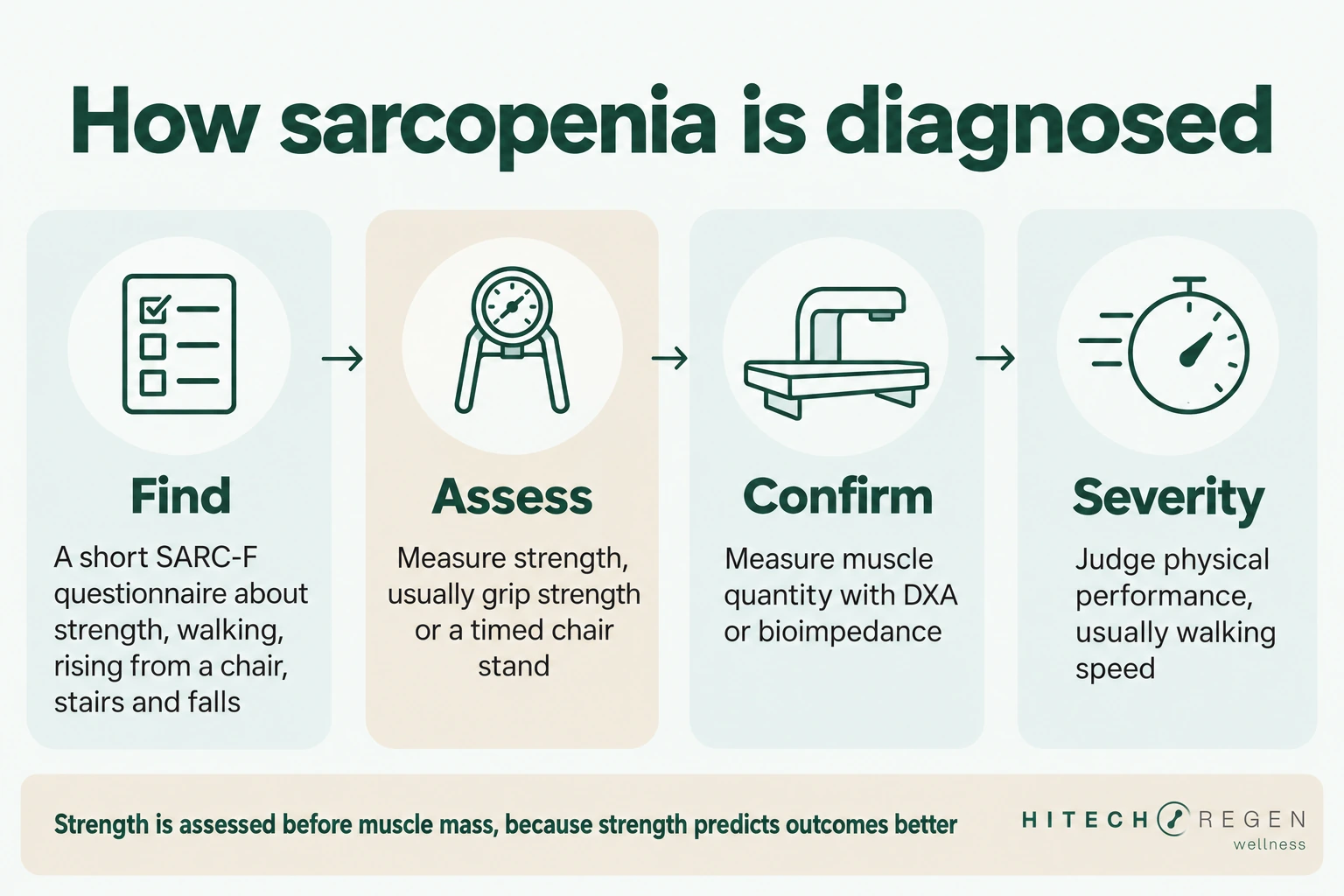
The European Working Group on Sarcopenia in Older People 2, known as EWGSOP2, set out the algorithm most clinicians now follow. StatPearls summarises it as find, assess, confirm, severity, abbreviated to F-A-C-S. Each step answers a different question, and the order is deliberate.
Find is a screening step, usually the SARC-F questionnaire. It asks about five things: strength, assistance with walking, rising from a chair, climbing stairs, and falls. It takes under a minute, needs no equipment, and is designed to be sensitive enough to flag people worth assessing properly.
Assess measures strength directly, most commonly with a handheld grip dynamometer or a timed chair-stand test. Confirm measures muscle quantity or quality, typically with DXA or bioimpedance. Severity is judged on physical performance, usually gait speed. The reason strength is assessed before mass is that strength predicts outcomes better than mass does, a point EWGSOP2 made explicitly when it revised the earlier criteria.
This matters for anyone being offered a body-composition scan as a standalone sarcopenia test. A scan on its own measures quantity. It does not establish the diagnosis, because the diagnosis requires reduced function as well.
What causes it
StatPearls describes the causes as multifaceted and not entirely understood, and lists contributing factors that include decreased type II muscle fibre size and number, inactivity, obesity, insulin resistance, reduced androgen and growth factor concentrations, inadequate protein intake, and a blunted muscle protein synthesis response to protein meals and to resistance exercise.
That last factor has a name worth knowing: anabolic resistance. An older person eating the same protein and doing the same training as a younger one builds less muscle from it. The practical consequence is not that training and protein stop working. It is that the doses that worked at 35 are no longer enough at 70, which is why the specific targets below are higher than general dietary advice.
Sarcopenia also travels with chronic illness. StatPearls notes that prevalence is greater in people with chronic obstructive pulmonary disease, chronic heart failure, chronic kidney disease, diabetes, HIV and cancer. If you are managing one of these, muscle loss is part of the picture rather than a separate problem, and our guide to the four stages of COPD covers how that interacts with breathing conditions specifically.
Muscle loss on GLP-1 weight-loss medications
A question that barely existed three years ago now arrives constantly: does semaglutide, tirzepatide or any of the related medications cause muscle loss? The honest answer is that they cause lean mass loss, that this is expected rather than aberrant, and that the scale of it is routinely overstated online in both directions.
A 2025 review titled Muscle loss and GLP-1R agonists use, published on PubMed Central, sets out what the trials found. In people with obesity, particularly where weight reduction is rapid or large, the decline in lean mass may account for up to 25 to 30 percent of total weight lost. In analyses of tirzepatide, about three-quarters of the weight lost was fat mass and about one-quarter was lean mass, proportions the authors note closely resemble those seen with diet-induced weight loss.
The second half of that finding is the part the alarming headlines leave out. Losing some lean mass while losing weight is normal and happens with any method. The review also reports that physical performance outcomes such as mobility and functional capacity are generally maintained, and states that moderate lean mass loss during therapy does not necessarily equate to clinically relevant impairment. Lean mass reduction is a body-composition measurement. Sarcopenia is a diagnosis that requires both reduced quantity and reduced function. They are not the same thing.
What the review does flag is who is at genuine risk. It identifies advanced age, rapid or large absolute weight loss, low dietary protein intake, a sedentary lifestyle, and conditions such as chronic kidney disease or long-standing diabetes as risk factors for greater lean tissue loss. It also notes that reduced protein intake is a common consequence of appetite suppression, which is the mechanism these medications work by. A 70-year-old who stops eating much because food has lost its appeal, and who does no strength work, is in a very different position from a 40-year-old who keeps training and keeps protein up.
| Question | What the published analyses show |
|---|---|
| How much of the weight lost is lean mass? | Up to 25 to 30 percent where weight loss is rapid or large. For tirzepatide, roughly one-quarter, close to what diet-induced weight loss produces. |
| Do strength and function drop too? | Generally maintained in the trials reported. Moderate lean mass loss did not equate to clinically relevant impairment. |
| Is this the same as sarcopenia? | No. Sarcopenia requires reduced muscle quantity and reduced function. Lean mass change alone is a body-composition finding. |
| Who is most at risk? | Older patients, rapid or large weight loss, low protein intake, sedentary lifestyle, chronic kidney disease, long-standing diabetes. |
| What reduces the risk? | Tailored resistance training alongside the medication, and protecting protein intake while appetite is suppressed. |
The review is direct about mitigation: tailored resistance exercise training can optimise body composition changes by preserving lean mass while achieving fat loss when combined with a reduced-calorie diet or incretin therapy. In other words, the countermeasure for muscle loss on these medications is the same countermeasure as for sarcopenia itself.
What actually rebuilds muscle
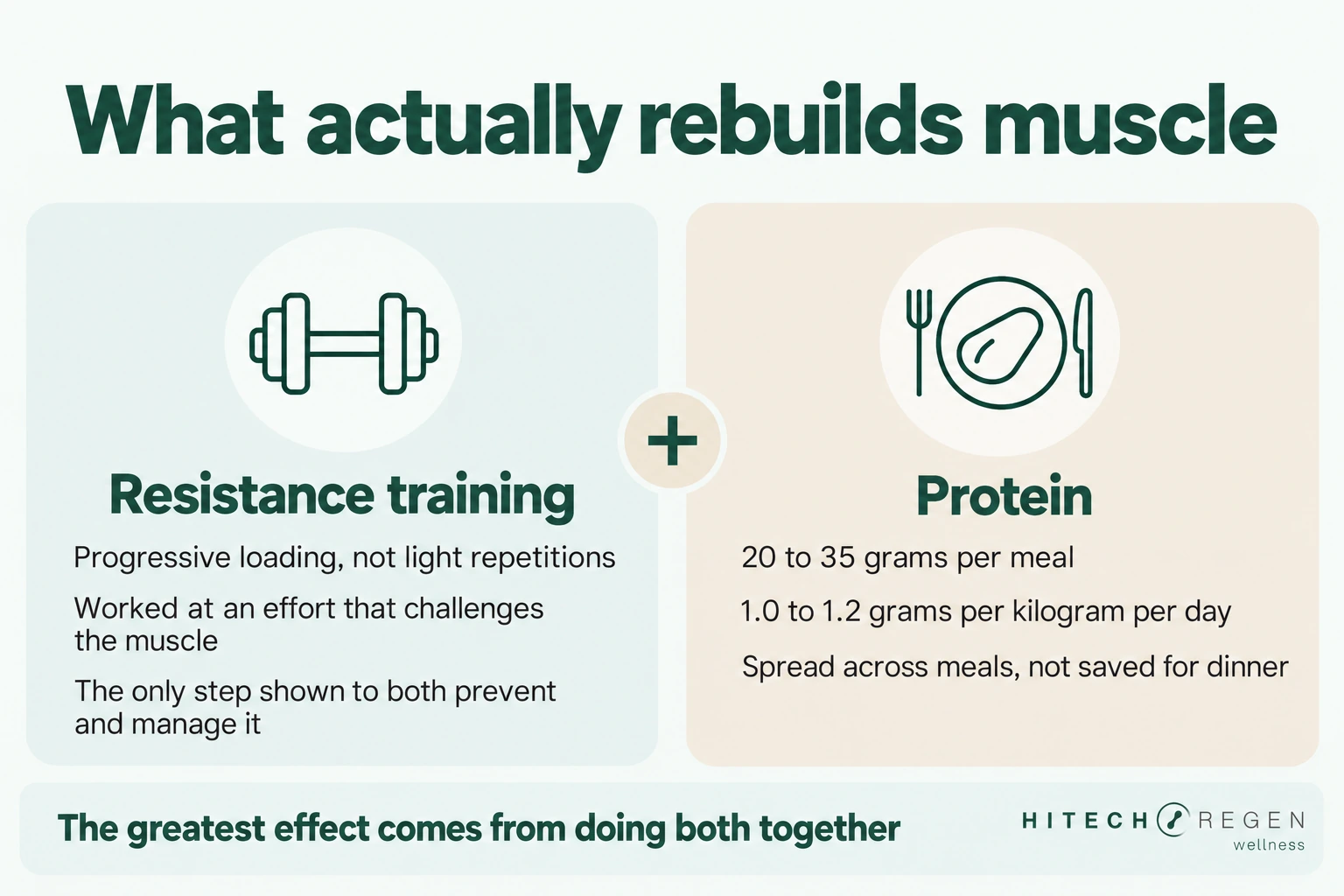
StatPearls is unambiguous on this. Physical activity, and resistance training in particular, effectively attenuates muscle loss and improves strength in sarcopenia, providing a means of both preventing and managing the condition. Increasing total protein intake through food or supplementation helps as well, and the greatest effects are observed when resistance training and a high protein diet are combined, where the two appear to act synergistically.
The specific numbers are worth quoting because general advice to eat more protein is too vague to act on.
| Intervention | Target from the literature | Why this number |
|---|---|---|
| Resistance training | Progressive loading, worked at an effort that genuinely challenges the muscle, not light repetitions. | It is the only intervention StatPearls describes as both preventing and managing the condition. |
| Protein per meal | 20 to 35 grams per meal | That range supplies enough amino acid content to maximise muscle protein synthesis at a single sitting. |
| Protein per day | 1.0 to 1.2 grams per kilogram of body weight per day | The intake recommended for patients with sarcopenia, above standard adult guidance. |
| The two combined | Both, consistently | StatPearls reports the greatest effects when resistance training and high protein intake are combined, acting synergistically. |
Two points about this that get lost. First, the protein target is per day and per meal, and the per-meal figure is the one people miss, because protein eaten mostly at dinner does not produce the same result as protein spread across the day. Second, nothing in the literature supports supplements, peptides or hormones as a substitute for the loaded stimulus. They are discussed as adjuncts at best.
Where supportive and regenerative care sits
People who have been training consistently and eating well, and who are still losing ground, reasonably ask what else exists. The honest answer is narrower than the marketing suggests.
There is no approved cell therapy for sarcopenia in the United States, and the FDA states plainly that there are currently no FDA-approved exosome products. The agency issued a public safety notification after serious adverse events in patients treated with unapproved products marketed as containing exosomes. Any provider offering to reverse age-related muscle loss with a biologic is describing something no published evidence supports.
What can be discussed honestly is supportive care aimed at energy, recovery and general wellbeing rather than at muscle mass itself, chosen with clear eyes and kept alongside the strength work rather than instead of it. We set out the differences between the main approaches in our comparison of exosomes, stem cells and PRP, and our guide to NMN and NAD+ covers the metabolic support question specifically.
How Hitech Regen approaches muscle loss and recovery
Hitech Regen provides physician-guided regenerative supportive care across Southern California, delivered in your home, which removes the travel that often makes consistency hardest for people whose mobility is already limited.
We are not a sports medicine practice and we do not program strength training. We do not replace the physician assessing you, and we will say plainly that if you are not doing progressive resistance work and not hitting your protein, that is where the available gains are, not with us. What we do is screen carefully and tell you what the evidence supports and what it does not. Options span cell-based protocols, exosome therapy and NAD+ therapy as metabolic support. You can read more about what we support on our longevity and vitality page, or book a consultation when you want that conversation.
Frequently asked questions
What are the first symptoms of sarcopenia?
Functional ones rather than visible ones. A weaker grip on lids and handles, needing hands to push up out of a chair, stairs feeling harder, walking more slowly than others your age, and more trips or near falls. Body weight often stays steady while muscle is replaced by fat, so the scale gives no warning.
How do you reverse sarcopenia?
Progressive resistance training combined with adequate protein is the only approach StatPearls describes as both preventing and managing it, and the two together produce the greatest effect. Strength and function can improve substantially at any age. Whether muscle mass returns fully depends on how long the loss has been running and on what else is going on medically.
Can the elderly regain muscle mass?
Yes, although the response is blunted compared with a younger person, a phenomenon called anabolic resistance. That is an argument for training harder and eating more protein rather than for giving up on it. Supervised programs in people in their seventies and eighties consistently show gains in strength and in walking speed.
Does semaglutide or tirzepatide cause muscle loss?
They cause lean mass loss, as any substantial weight loss does. Published analyses put it at up to 25 to 30 percent of total weight lost where loss is rapid or large, and about one-quarter for tirzepatide, similar to diet-induced weight loss. Physical function was generally maintained. Resistance training and protecting protein intake are the recommended countermeasures.
Is GLP-1 muscle loss the same as sarcopenia?
No. Sarcopenia requires both reduced muscle quantity and reduced function. Lean mass change on a body-composition scan is a measurement, not a diagnosis. Someone can lose lean mass on these medications and keep normal strength and mobility, which is what the trial data mostly showed.
How much protein do I need for sarcopenia?
StatPearls cites 1.0 to 1.2 grams per kilogram of body weight per day for patients with sarcopenia, and 20 to 35 grams per meal, because that per-meal amount is what maximises muscle protein synthesis at one sitting. Spreading protein across meals matters as much as the daily total. Kidney disease changes these targets, so set them with your physician.
Is there a treatment or supplement that rebuilds muscle without exercise?
Not one supported by the evidence. No cell therapy is approved for sarcopenia in the United States, and the FDA states there are currently no FDA-approved exosome products. Supplements and supportive therapies are discussed as adjuncts to loaded training and adequate protein, never as replacements for them.
Want to know whether supportive care adds anything in your case?
Take the two-minute screening and we will tell you honestly whether supportive regenerative care fits alongside your strength work and nutrition, or whether your effort is better spent entirely on those. If the answer is no, you will have that answer in two minutes.
Physician-guided care at home. We work alongside your own physician, and we put quotes in writing.