
The 4 Stages of COPD: What Each Stage Means and What Can Help

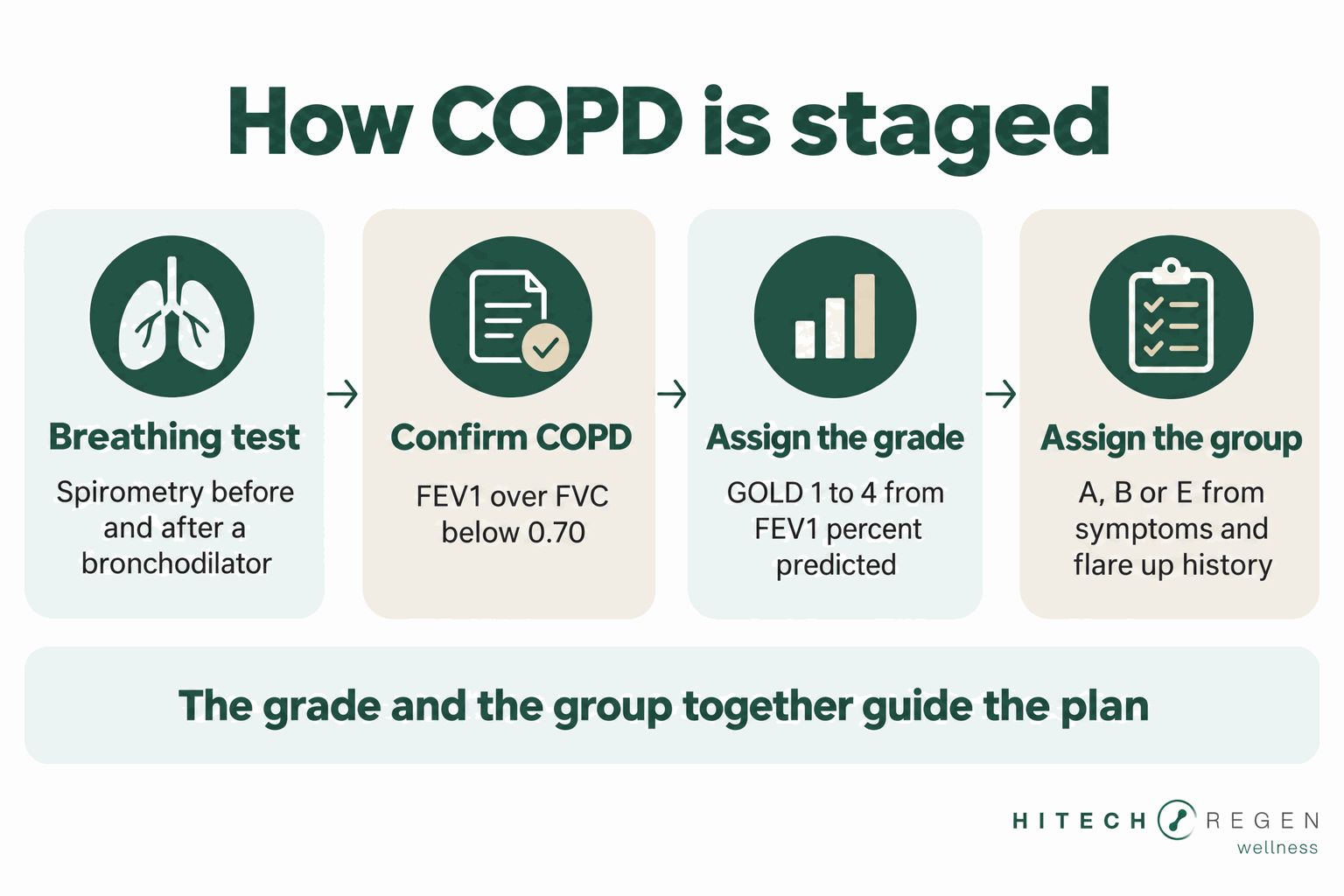
COPD is staged in four grades, GOLD 1 through GOLD 4, and the grade comes from a single spirometry number: how much air you can force out in one second, called FEV1, compared with what is predicted for someone your age, height and sex. Mild is an FEV1 at or above 80 percent of predicted, moderate is 50 to 79 percent, severe is 30 to 49 percent, and very severe is below 30 percent.
The diagnosis itself rests on a different number, a post bronchodilator FEV1 to FVC ratio below 0.70, and your stage is only one of three things your physician weighs. This guide explains what each stage means, what the research actually says about life expectancy at each one, what helps at every stage, and where regenerative medicine genuinely sits in that picture. It pairs with our COPD support page.
How COPD is staged
Staging starts with spirometry, a breathing test you take after using a bronchodilator so the measurement reflects the airflow limitation that does not reverse. Two numbers matter. FVC is the total volume you can force out. FEV1 is how much of that comes out in the first second. In healthy lungs most of the air leaves quickly, so FEV1 is a large share of FVC.
StatPearls, the peer reviewed clinical reference hosted by the National Center for Biotechnology Information, states that a post bronchodilator FEV1 to FVC ratio below 0.70 is what defines COPD spirometrically. Once that ratio confirms the diagnosis, your FEV1 as a percentage of predicted places you in one of the four GOLD grades.
| GOLD grade | FEV1, percent of predicted | Usually called | What it commonly looks like |
|---|---|---|---|
| GOLD 1 | 80 percent or above | Mild | Often no noticeable limitation. Many people are unaware they have it, or put a lingering cough down to smoking or age. |
| GOLD 2 | 50 to 79 percent | Moderate | Breathlessness on hills, stairs or hurrying. This is the stage at which most people first seek help. |
| GOLD 3 | 30 to 49 percent | Severe | Breathlessness on everyday tasks, reduced walking distance, more frequent flare ups and a greater effect on daily life. |
| GOLD 4 | Below 30 percent | Very severe | Marked limitation, breathlessness at rest or with minimal effort, and flare ups that can be life threatening. |
Not sure what your numbers mean for you?
Staging belongs with the physician who ordered your spirometry, and nothing here replaces that conversation. If you already have a care team and you are asking what supportive options exist alongside it, our two minute screening tells you whether a conversation with our physician is worth your time.
Physician-guided. Written quotes, no pressure. Serving Southern California at home.
Why your grade is only part of the assessment
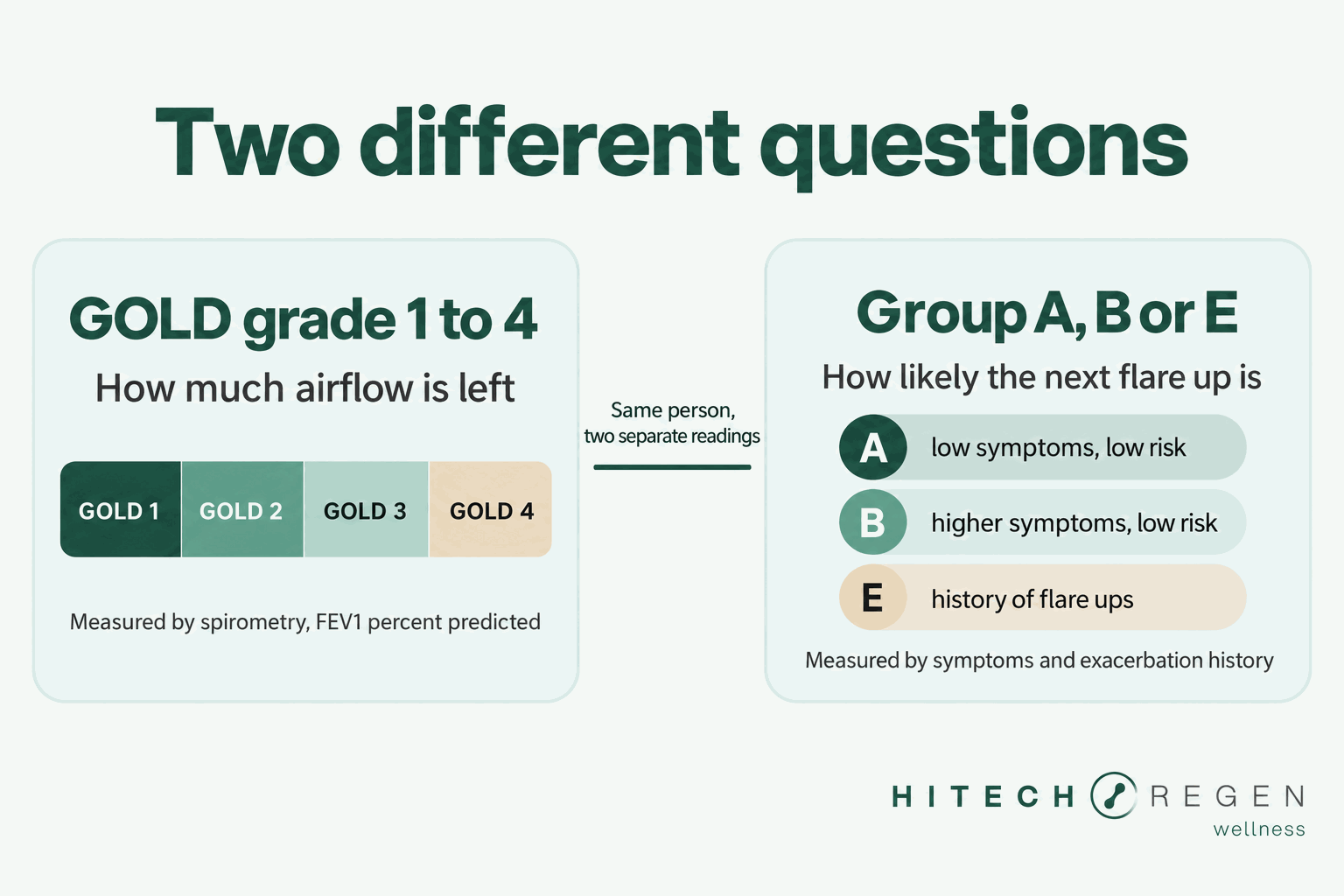
Two people can have an identical FEV1 and live completely different lives with it. That is why the GOLD strategy stopped treating the spirometric grade as the whole assessment. Since the 2023 revision, patients are also placed in a group, A, B or E, based on symptoms and on how many flare ups they had in the past year.
As StatPearls summarises it, group A covers people with zero or one moderate exacerbation that did not require hospitalisation and relatively few symptoms. Group B covers people with more significant symptoms, defined as an mMRC breathlessness score of 1 or above or a COPD Assessment Test score of 10 or above. Group E, where the E stands for exacerbations, covers anyone with two or more moderate flare ups in the prior year, or one or more that put them in hospital.
The practical consequence matters more than the letters. Your grade describes your lungs. Your group describes your life and your risk of the next flare up, and it is the group, far more than the number, that drives what your physician prescribes. If your stage has been explained to you as a countdown, you have been given half the story.
What each stage tends to feel like
At GOLD 1, most people feel well. A morning cough or a little extra phlegm is easy to attribute to something else, which is why this stage is so often found by accident, on a test ordered for another reason. It is also the stage at which intervening does the most good.
At GOLD 2, breathlessness starts to shape choices. People walk slower than others their age, take the lift, or quietly drop activities they used to enjoy. Because the adjustment is gradual, many describe it as getting older rather than getting worse, and that framing delays care.
At GOLD 3, the limitation is hard to miss. Getting dressed, carrying shopping or crossing a car park can be enough to cause breathlessness, and flare ups become both more frequent and slower to recover from. Fatigue and disturbed sleep often matter as much to quality of life as the breathlessness itself.
At GOLD 4, breathlessness can be present at rest, and exacerbations can be dangerous rather than simply unpleasant. Care at this stage focuses heavily on preventing flare ups, maintaining function, and treating the other conditions that usually travel with advanced COPD, cardiovascular disease above all.
COPD and life expectancy: what the numbers actually say
This is the question behind most searches about staging, so here is a direct answer from real data rather than a scary round number.
The most widely cited analysis is Shavelle and colleagues, published in the International Journal of COPD in 2009 using the NHANES III follow up study. Rather than predicting a lifespan, it measured years of life lost at age 65 compared with people of the same age without COPD, and it separated the effect of the disease from the effect of smoking. The difference between those two things is the single most useful fact in the whole paper.
| Smoking status | GOLD 1 | GOLD 2 | GOLD 3 or 4 |
|---|---|---|---|
| Current smoker | 0.3 years | 2.2 years | 5.8 years |
| Former smoker | No measurable loss | 1.4 years | 5.6 years |
| Never smoked | No measurable loss | 0.7 years | 1.3 years |
Read the never smoked row against the current smoker row. At GOLD 3 or 4, the gap between them is more than four years. The authors put it plainly: the effect is most marked in current smokers, and that is further reason for smokers to quit. Mild COPD in someone who has stopped smoking barely moves the number at all.
Clinicians also rarely use the spirometric grade alone for prognosis. The BODE index, which combines body mass index, obstruction, breathlessness and exercise capacity, tracks outcomes far better, and StatPearls reports four year mortality across its range running from roughly 0 to 4 percent at the lowest scores up to 56 to 94 percent at the highest. Two people at GOLD 3 can sit at opposite ends of that range, and what separates them is largely modifiable.
What helps, and what helps most
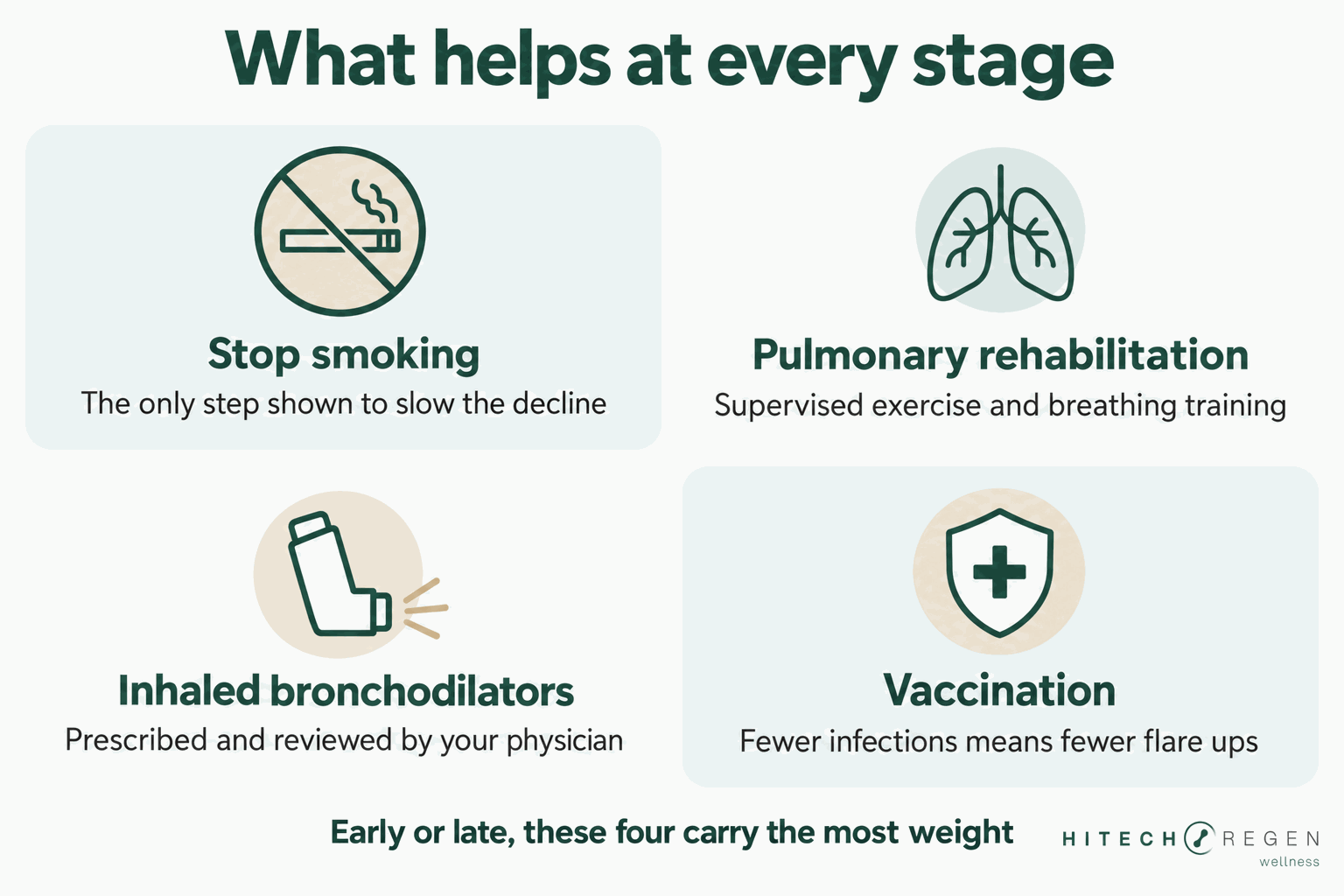
Stopping smoking is the only intervention shown to change the slope of decline rather than the symptoms along the way. Nothing else in COPD care comes close, at any stage, at any age.
Beyond that, standard care is built around bronchodilators to open the airways, inhaled corticosteroids for selected patients with frequent exacerbations, and pulmonary rehabilitation, a supervised programme of exercise and education that consistently improves breathlessness and walking distance. Vaccination reduces the infections that trigger flare ups. Supplemental oxygen is prescribed when blood oxygen is genuinely low, not for breathlessness alone. And because cardiovascular disease so often travels with COPD, treating it is part of treating the patient.
The GOLD strategy is explicit that treatment is individualised on symptoms, exacerbation risk, side effects, other conditions and access, rather than assigned from the grade. If your care has never included a pulmonary rehabilitation referral or a serious cessation conversation, those two things are worth raising before anything else.
Where regenerative research actually sits
People at GOLD 3 and 4 who feel they have exhausted standard care reasonably ask what else exists, and the honest answer is narrower than the marketing suggests.
Mesenchymal stromal cells have been studied in COPD, and the published work is genuinely early: small trials sized to test safety rather than benefit, with short follow up and no demonstrated restoration of lung function. There is no approved cell therapy for COPD in the United States. The FDA maintains a public safety alert about the marketing of unapproved stem cell and exosome products, and has acted against clinics selling them with cure claims. Any provider who offers to reverse your COPD is telling you something no evidence supports.
What can be discussed honestly is supportive care, framed around comfort, energy and general wellbeing rather than lung function, chosen with clear eyes and kept alongside your pulmonary care rather than instead of it. We set out the differences between the main approaches in our comparison of exosomes, stem cells and PRP.
How Hitech Regen approaches respiratory concerns
Hitech Regen provides physician-guided regenerative supportive care across Southern California, delivered in your home, which matters more here than in most conditions, because travelling to an appointment can itself be the hardest part of the day for someone at GOLD 3 or 4.
We are not a pulmonology practice. We do not stage COPD, we do not manage inhalers, and we do not replace pulmonary rehabilitation or the physician directing your care. What we do is screen carefully and say plainly what the evidence supports and what it does not. Options span cell-based protocols, exosome therapy and NAD+ therapy as metabolic support. You can read more about the conditions we support on our respiratory support page, or book a consultation when you want that conversation.
Frequently asked questions
What are the 4 stages of COPD?
They are GOLD grades 1 to 4, set by FEV1 as a percentage of predicted: mild at 80 percent or above, moderate at 50 to 79 percent, severe at 30 to 49 percent, and very severe below 30 percent. The diagnosis itself requires a post bronchodilator FEV1 to FVC ratio below 0.70.
How do doctors decide which stage I am in?
With spirometry performed after a bronchodilator, so the result reflects airflow limitation that does not fully reverse. Your FEV1 is compared with the predicted value for your age, height and sex. Symptoms and flare up history are assessed separately and place you in group A, B or E.
What is the life expectancy with stage 3 or stage 4 COPD?
There is no single figure. The NHANES III follow up analysis found roughly 5.8 years of life lost at age 65 for current smokers at GOLD 3 or 4, 5.6 years for former smokers and 1.3 years for never smokers. Those are population averages, and smoking status moves them more than the stage does.
Can COPD go back to an earlier stage?
The structural damage is not considered reversible, so the grade rarely improves. What can improve markedly is how you function within it. Stopping smoking, pulmonary rehabilitation and preventing flare ups all change the trajectory even when the number on the spirometry report does not.
How fast does COPD progress?
It varies widely, and flare ups are a large part of why. Each significant exacerbation can leave lung function slightly lower than before, which is why preventing them, through vaccination, adherence and early treatment, is a central part of care rather than an afterthought.
Is stem cell therapy approved for COPD?
No. No cell therapy is approved for COPD in the United States, and published trials are small and early, designed mainly around safety. The FDA has issued a public safety alert about unapproved stem cell and exosome products, so any provider should frame this as investigational and nothing more.
Does supportive regenerative care replace inhalers or pulmonary rehab?
No, and a responsible provider will say so first. Inhaled therapy, rehabilitation, vaccination and cessation support are the evidence based core of COPD care. Supportive regenerative care is an optional addition that runs alongside them, never a substitute, and never a reason to stop anything your physician prescribed.
Want a straight answer about your own situation?
Take the two minute screening to see whether supportive regenerative care fits alongside your COPD care, or call and ask us directly. If the answer is no, we will tell you that, and you will have spent two minutes finding out.
Physician-guided care at home. We work alongside your pulmonologist, and we put quotes in writing.