
NMN vs NAD+: What Actually Raises Your NAD Levels
NMN and NAD+ are not two competing products. NAD+ is the molecule your cells actually use, and NMN is one of the raw materials they build it from. Asking whether to take NMN or NAD+ is a little like asking whether to buy flour or bread: only one of them is the thing you want, and the question is really which route gets you there.
That matters because NAD+ taken by mouth is a poor delivery route. The molecule is large and unstable in the gut, so most oral products are built around precursors instead, principally NMN and nicotinamide riboside. This guide explains how the three relate, what human trials have actually shown about raising NAD levels, what changed in the regulatory status of NMN in 2025, and how the supplement route compares with a physician-guided NAD+ therapy protocol.
What NAD+ does, and why levels matter to people
Nicotinamide adenine dinucleotide, NAD+, is a coenzyme present in every cell you have. Its central job is energy: it carries electrons through the reactions that turn food into usable fuel. It is also the substrate for a family of enzymes involved in DNA repair and in regulating how cells respond to stress, which is why it turns up so often in research on ageing and metabolic health.
NAD+ is not stored in a tank that slowly drains. Cells make it, use it, break it down and remake it continuously. Research has reported that tissue NAD+ declines with age and under metabolic stress, and it is that observation, rather than any approved treatment, that drives the whole precursor supplement market. It is worth being precise about the state of the evidence: the decline is well described, and whether topping it up produces the outcomes people hope for is still being studied.
NMN, NR and NAD+: how the three relate
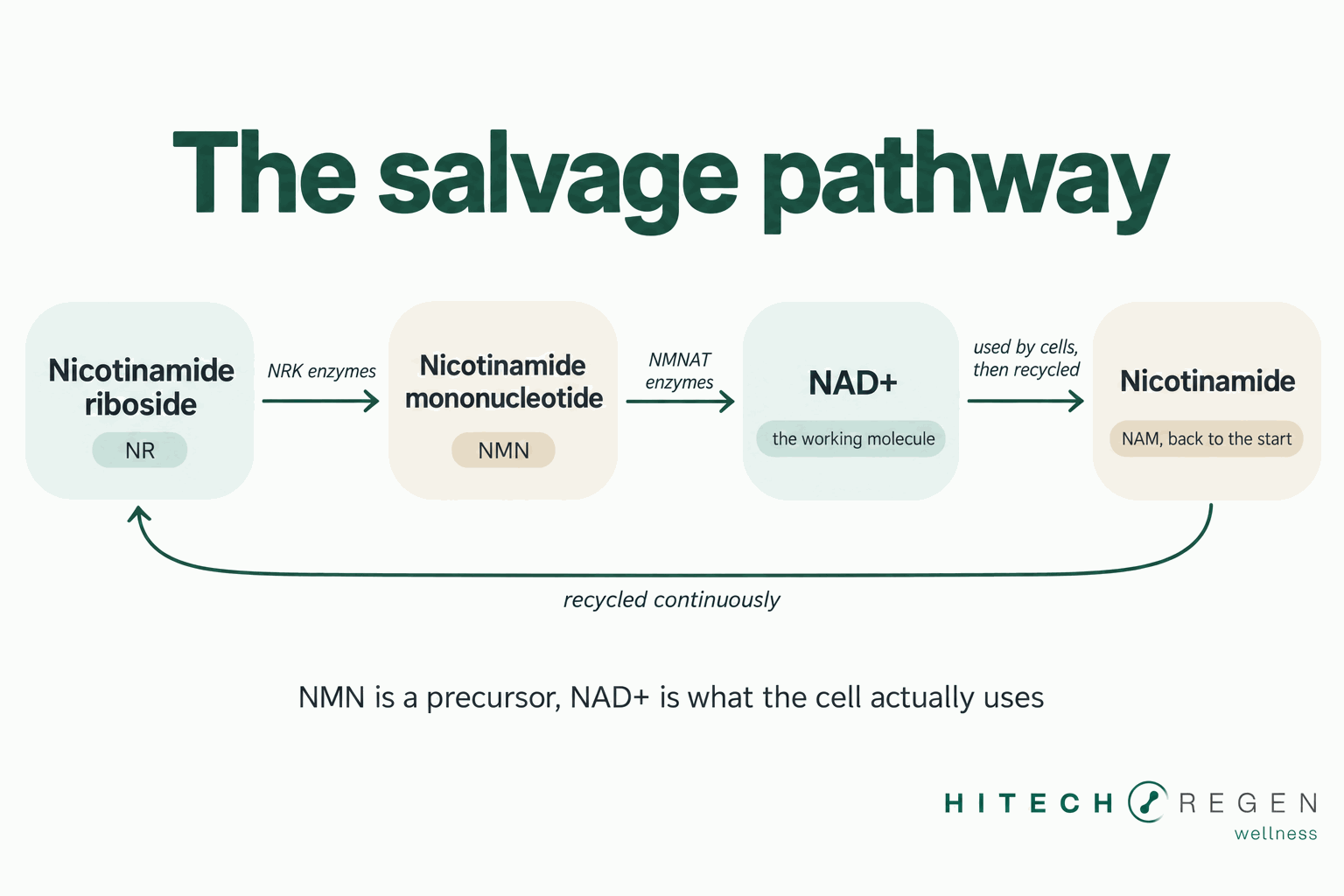
The body builds NAD+ through what is called the salvage pathway, recycling vitamin B3 forms rather than making the molecule from scratch. NMN sits one step away from NAD+ on that pathway. Nicotinamide riboside, NR, sits one step further back and is converted into NMN first. Both are precursors. Neither is NAD+ itself.
| Molecule | What it is | How the body handles it | Where the human evidence stands |
|---|---|---|---|
| NAD+ | The active coenzyme cells use | Large and unstable in the gut, so oral NAD+ is largely broken down before it is absorbed intact | Studied as a clinic-administered protocol rather than as an oral product |
| NMN | A direct precursor, one step from NAD+ | Absorbed and converted, then used to build NAD+ through the salvage pathway | Several small human trials, including placebo-controlled work showing raised blood NAD levels |
| NR | A precursor one step behind NMN | Converted to NMN first, then to NAD+ | The more extensively studied of the two precursors in humans, with a longer regulatory track record |
| Niacin and nicotinamide | Ordinary vitamin B3 forms | Also feed the same pathway, cheaply | Long established as vitamins, with flushing and dosing considerations of their own |
Wondering whether a supplement is enough for your goals?
The honest answer depends on what you are actually trying to change, and on your health history. Our two minute screening is the quickest way to find out whether a physician conversation about NAD+ therapy is worth your time, or whether an oral precursor is the sensible starting point.
Physician-guided. Written quotes, no pressure. Serving Southern California at home.
What actually raises NAD levels in people
This is where the marketing and the evidence part company, so it is worth being specific about what has been measured in humans rather than in cells or mice.
The clearest placebo-controlled result for NMN comes from Okabe and colleagues, published in Frontiers in Nutrition in 2022. Thirty healthy adults were randomised to 250 mg of NMN a day or placebo for 12 weeks, double blind. Whole blood NAD+ levels rose significantly in the NMN group at weeks 4, 8 and 12, with the largest increase at four weeks, and the authors reported no abnormalities in physiological or laboratory testing and no obvious adverse effects over the 12 weeks.
Three caveats belong with that result. Thirty participants is a small trial. Blood NAD+ is a proxy, and a rise in the blood does not prove a rise in the tissue you care about. And raising a biomarker is not the same as producing a health outcome, which is the harder question the field is still working on. NR has been studied more extensively in humans and also raises blood NAD, so the fair summary is that both precursors do measurably what they claim to do at the biomarker level, and neither has yet earned the sweeping claims made for it.
Worth noting too: the same trial found that a related metabolite rose alongside NAD+, while NMN itself did not accumulate in the blood. The body converts it rather than stockpiling it, which is the expected behaviour for something on a recycling pathway and a reason to be sceptical of products sold on dose size alone.
The NMN regulatory story, which changed in 2025
If you shopped for NMN a couple of years ago and found it disappearing from major retailers, there is a reason, and it has since reversed.
The FDA had taken the position that NMN was excluded from the definition of a dietary supplement under the drug preclusion rule, because it had been authorised for investigation as a drug. On 29 September 2025 the agency issued letters reversing that position, concluding that NMN is not excluded and may remain available as a supplement ingredient. The reasoning turned on evidence that NMN had been marketed as a supplement before the drug investigation began.
Two things follow for a buyer. NMN is lawful to sell again in the United States, and it is still a new dietary ingredient, which means manufacturers carry notification obligations and quality varies between them. Regulatory permission to sell a product is not the same as evidence that it works, and it is certainly not FDA approval of any health claim. Ask for third party testing before you ask about price.
Oral precursor or a clinic protocol?
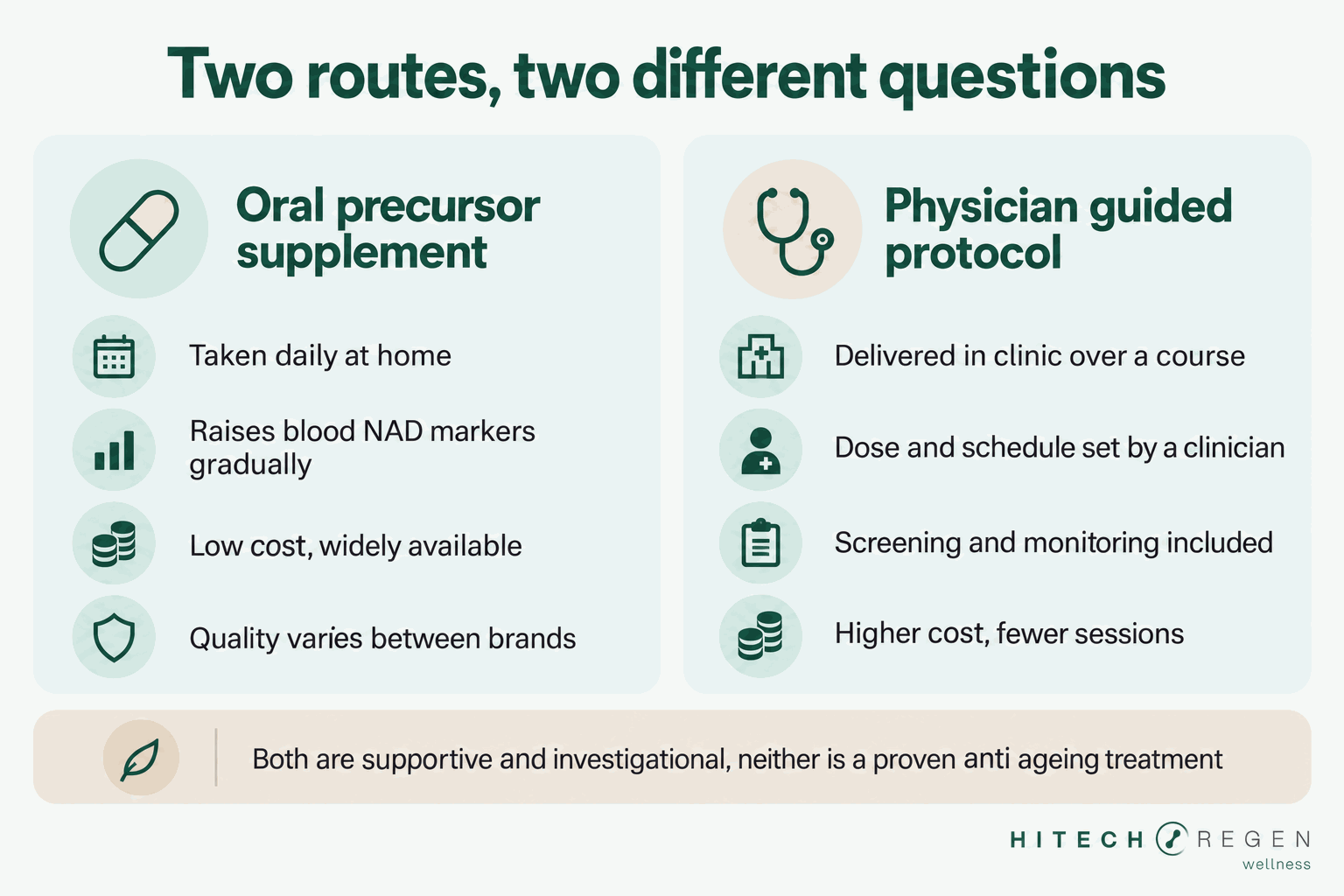
The two routes answer different questions, and the comparison is usually framed badly.
An oral precursor is inexpensive, easy to sustain and reasonable for someone with general wellness goals and no complicating health history. It is a daily habit rather than an event, and the human data behind it, while thin, is real.
A physician-guided NAD+ therapy protocol is a different proposition: it involves screening, a clinician, a defined course rather than an open ended habit, and a conversation about whether it suits your health history at all. It bypasses the absorption problem that makes oral NAD+ impractical. It is also investigational, not FDA approved for any condition, and it costs considerably more. We set out what it does and does not do, including realistic expectations and side effects, in our guide to NAD+ therapy benefits.
The one comparison worth refusing is the claim that either route is a treatment for a named disease. Neither is, and a provider who tells you otherwise is selling rather than informing.
How Hitech Regen approaches this
Hitech Regen provides physician-guided regenerative supportive care across Southern California, delivered in your home. Every plan starts with a health history review and a candid conversation about what the evidence supports.
In practice that means we tell some people that an oral precursor and better sleep would serve them better than anything we offer, and we say so before taking any money. For those for whom a clinic protocol does make sense, options span NAD+ therapy, exosome therapy and cell-based protocols. You can see the full range on our conditions page, or book a consultation to talk it through.
Frequently asked questions
Is NMN the same as NAD+?
No. NAD+ is the coenzyme your cells use. NMN is a precursor your body converts into NAD+ through the salvage pathway. Because NAD+ itself is poorly absorbed when taken by mouth, oral products are generally built around precursors such as NMN or nicotinamide riboside instead.
Which is better, NMN or NR?
Neither has been shown to be decisively better in humans. Both are precursors that raise blood NAD levels in trials. NR has the longer human research record and regulatory history, NMN sits one step closer to NAD+ on the pathway. Product quality and third party testing matter more than the choice between them.
How do you increase NAD levels?
Through precursors, by mouth or under clinical supervision. A placebo-controlled trial of 250 mg of NMN daily for 12 weeks raised whole blood NAD+ significantly. Sleep, exercise and avoiding excess alcohol also affect NAD metabolism, and they cost nothing.
Is NMN legal to buy in the United States?
Yes. On 29 September 2025 the FDA reversed its earlier position and concluded that NMN is not excluded from the definition of a dietary supplement. It remains a new dietary ingredient with notification requirements for manufacturers, so quality still varies between brands.
How long does NMN take to work?
At the biomarker level, quickly. Blood NAD+ rose by week four in the placebo-controlled trial, with the largest increase at that point. Whether and when that translates into anything you notice is a separate question that current human evidence does not answer confidently.
Are NMN or NAD+ approved to treat any condition?
No. NMN is a supplement ingredient, not an approved drug, and NAD+ therapy is investigational rather than FDA approved for any condition. Anyone presenting either as a treatment for a named disease is going beyond what the evidence and the regulators support.
Can I take NMN alongside a clinic protocol?
That is a question for the physician who knows your health history and your medications, not for an article. Bring the actual bottle to the conversation, because dose and third party testing matter more than the brand name on the label.
Not sure which route fits you?
Two minutes of screening will tell you more than another hour of comparison articles. If an oral precursor is the sensible answer for you, we will say so, and you will not have wasted a consultation finding out.
Physician-guided care at home. Honest screening, and quotes in writing.