
Stem Cell Therapy for Knees and Back Pain: Evidence, Cost, Recovery
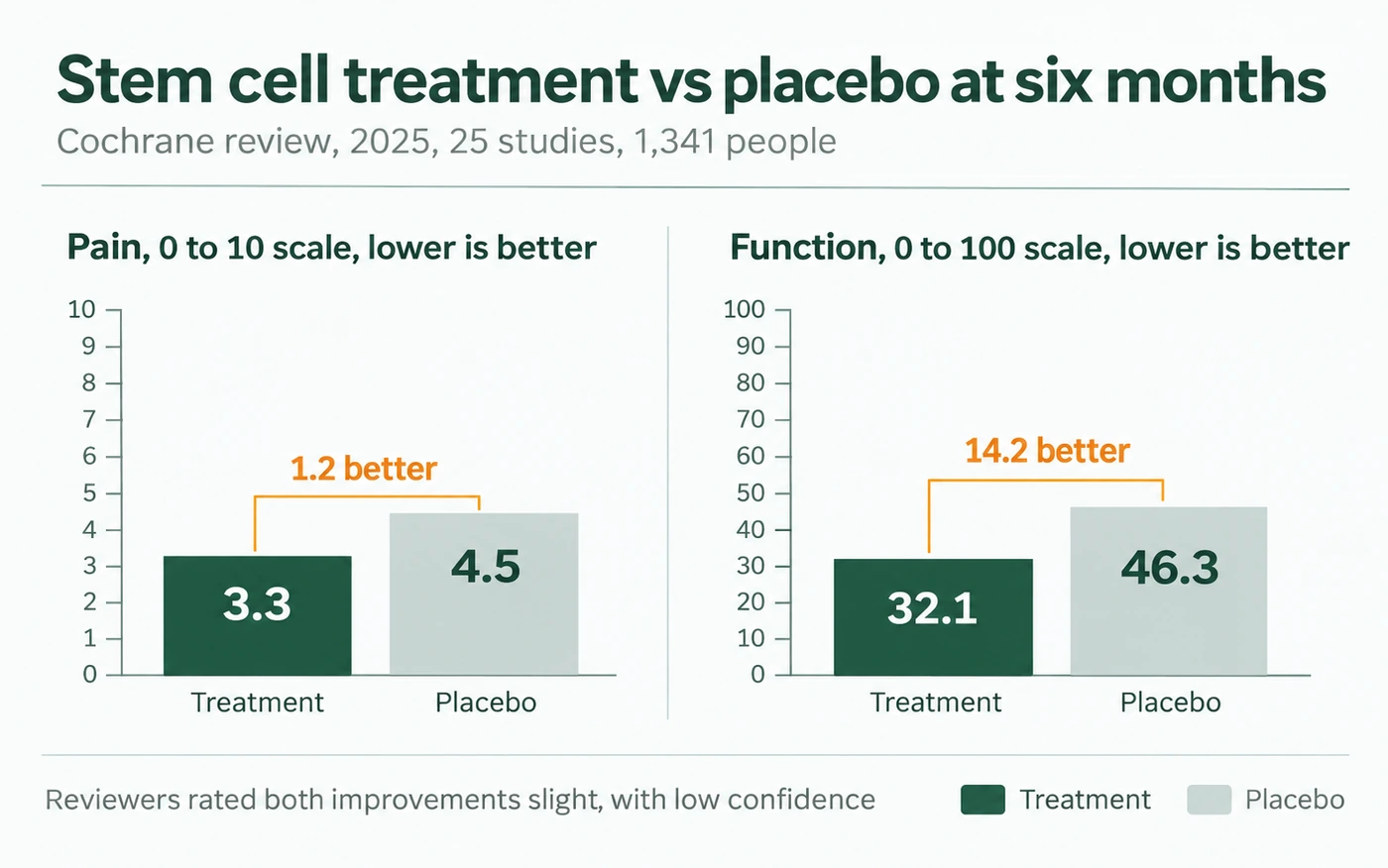
The best available evidence on stem cell therapy for knees comes from a Cochrane systematic review published in April 2025, which pooled 25 studies covering 1,341 people. Against a placebo procedure, it found pain about 1.2 points better on a 0 to 10 scale at six months, and function about 14.2 points better on a 0 to 100 scale. Those are real improvements. They are also described by the reviewers themselves as slight, and their confidence in the estimates is low.
That single paragraph is more than most clinic pages on this subject will tell you, and it is the honest starting point for deciding whether this is worth your money. This guide covers what the research found for knees and separately for back pain, what the procedure involves, what a course costs in the wider market, recovery, and the specific questions that separate a careful provider from a careless one. It pairs with our stem cell therapy page.
What the knee evidence actually shows
The Cochrane Collaboration produces the systematic reviews that sit at the top of the evidence hierarchy, and its April 2025 review of stem cell treatment for knee osteoarthritis is the most complete answer currently available. It is worth reading its findings in detail rather than in summary, because the detail is where the useful information sits.
| Outcome at six to twelve months | What the review found | How confident the reviewers were |
|---|---|---|
| Pain | 1.2 points better on a 0 to 10 scale. Treated group rated pain 3.3, placebo group 4.5. | Low confidence. The reviewers describe the improvement as slight. |
| Function | 14.2 points better on a 0 to 100 scale. Treated group 32.1, placebo group 46.3. | Low confidence, same caveat. |
| Quality of life | Unclear. Treated group rated 68.1, placebo group 45.3, but the reviewers do not draw a conclusion. | Uncertain. |
| Treatment judged a success at 12 months | 683 per 1,000 with treatment, 530 per 1,000 with placebo, so 153 more per 1,000. | Uncertain. |
| Serious adverse events at 12 months | 16 per 1,000 with treatment, 23 per 1,000 with placebo. No withdrawals due to harm in either group. | Uncertain. Safety is listed as an open question. |
| Slowing the disease itself | Not assessed in a single one of the 25 studies. | No evidence either way exists. |
Source: Cochrane Database of Systematic Reviews, April 2025, review CD013342, 25 studies and 1,341 participants, of which 8 studies and 459 participants were placebo controlled.
Three things in that table deserve more weight than they usually get.
The first is the placebo column. People who received a placebo procedure also improved, and they improved substantially. The treatment effect is the gap between the two columns, not the whole improvement a patient feels. Any clinic showing you before and after pain scores without a comparison group is showing you that whole improvement and letting you assume the treatment caused all of it.
The second is the last row. Disease progression was not assessed in any of the twenty five studies. That means there is no evidence that this treatment slows arthritis, rebuilds cartilage or changes what your knee looks like on a scan in five years. If a provider tells you it regrows cartilage, they are describing something the research has not measured, let alone demonstrated.
The third is why confidence is low. The reviewers state plainly that the optimal preparation and dose of stem cells is unknown and varied across the studies. They also note that up to three larger studies were conducted and then withdrawn by their own investigators before reporting results. A field where the biggest trials go unpublished is a field to enter with your eyes open.
Want to know whether you are even a candidate?
The evidence above is an average across 1,341 people, and averages do not tell you about your knee. Our two-minute screening asks what is actually going on with your joint and what you have already tried, and tells you whether a conversation with our physician is worth your time. If a knee replacement consult or physical therapy would serve you better, we will say so.
Am I a candidate?Call 818-938-9023
Physician-guided. Written quotes, no pressure. Serving Southern California at home.
What the back pain evidence shows
Back pain is a different question with a different literature, and it is generally more favorable, though from a smaller base.
A 2025 systematic review and meta-analysis published in the Asian Spine Journal by Rahyussalim and colleagues looked specifically at mesenchymal stem cells delivered into the disc for chronic low back pain caused by degenerative disc disease. It included only randomized controlled trials against a sham or placebo comparison, which is a stricter bar than most reviews in this field apply. It found statistically significant improvements in both pain and in the Oswestry Disability Index, a standard measure of how much back pain limits daily activity, and reported that the magnitude of improvement increased with longer follow-up.
The authors conclude that the approach appears to be safe and effective, offering modest improvements in pain and function for patients whose chronic low back pain comes from degenerative disc disease and who have not responded to conservative treatment. The two qualifiers in that sentence are the important part: modest, and for people who have already tried conservative care without success.
Note also what this evidence is not about. It covers discogenic pain from disc degeneration. It does not cover back pain from spinal stenosis, from a compressed nerve root, from instability, or from the many cases where no clear structural cause is found at all. Those are different problems, and a review of disc treatment says nothing useful about them.
Where this sits legally in the United States
This part is short and it matters more than any effect size.
There is no FDA-approved stem cell product for knee osteoarthritis or for back pain in the United States. The FDA has issued public warnings about clinics marketing unapproved stem cell and exosome products, and states plainly that there are currently no FDA-approved exosome products. Treatments offered in this space are investigational. A provider who describes them as approved, proven or cleared for your condition is either confused or is misleading you, and either is a reason to go elsewhere.
Insurance follows the same logic. Because these treatments are investigational, they are not covered by medical insurance, and you should assume the full cost is yours.
What a course costs
Published third-party clinic listings in the United States for a single knee commonly run in the low to mid thousands of dollars, with both knees or a knee plus a spinal level costing proportionally more. Those are market figures offered as context, not Hitech Regen pricing, and the spread between the cheapest and most expensive listings is wide enough that the number alone tells you very little.
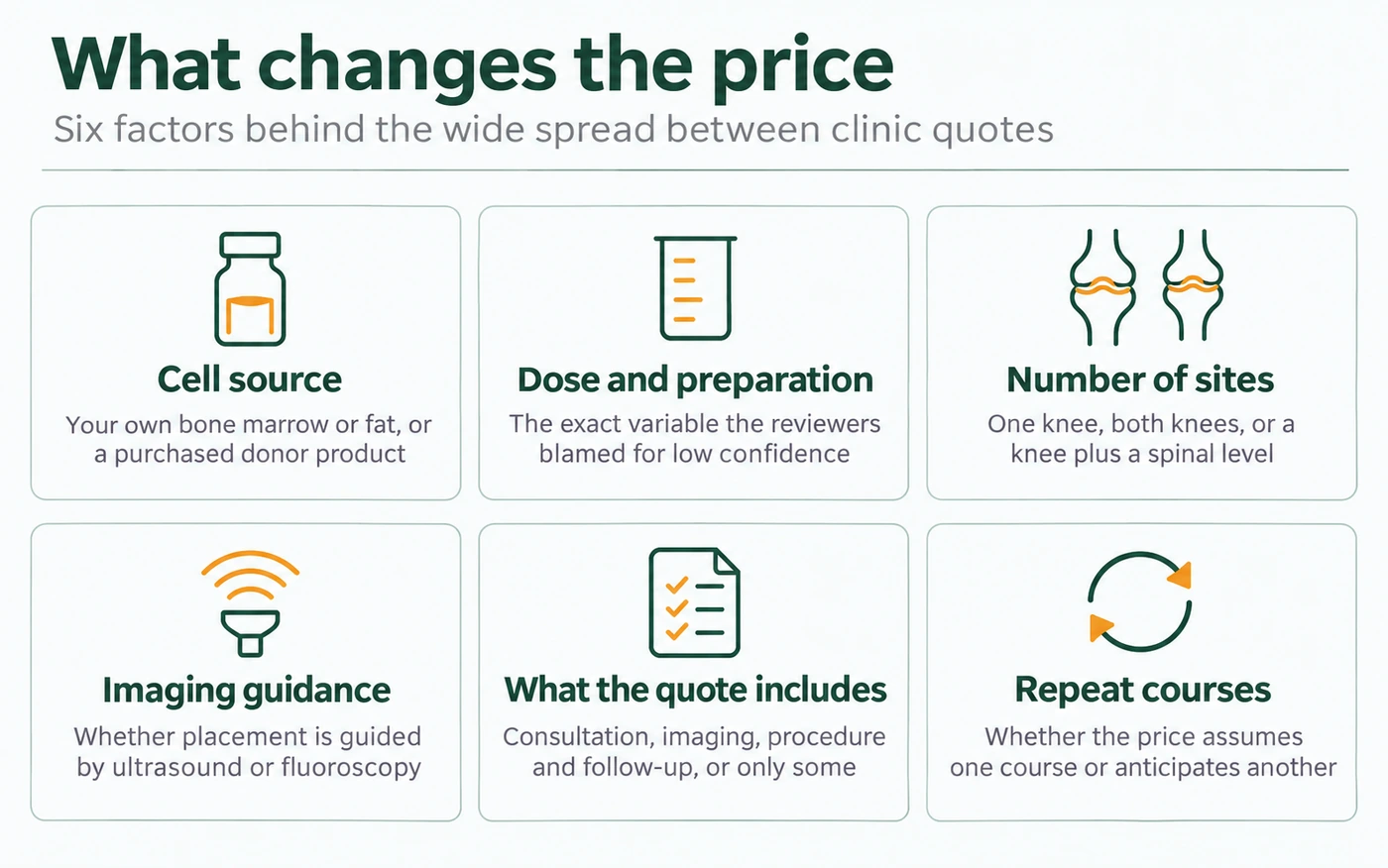
What drives that spread is worth understanding, because it is also what determines whether you are buying the thing the studies looked at.
| What changes the price | Why it matters to you |
|---|---|
| Cell source | Cells taken from your own bone marrow or fat, versus a purchased donor product. These are materially different things at materially different prices. |
| Dose and preparation | The Cochrane reviewers named unknown and varying dose and preparation as a main reason their confidence was low. A clinic should be able to tell you both. |
| Number of sites treated | One knee, both knees, or a knee plus a spinal level. Priced per site in most listings. |
| Imaging guidance | Whether placement is guided by ultrasound or fluoroscopy, which affects both accuracy and cost. |
| What the quote includes | Consultation, imaging, the procedure itself, follow-up visits and any repeat course. Quotes that look cheap often exclude several of these. |
| Repeat courses | Whether the quoted price assumes one course or anticipates another later. |
Our guide to what stem cell therapy costs goes into the market ranges and the insurance position in more depth, including why quotes vary so widely between clinics.
What the procedure and recovery involve
If cells are taken from your own body, the visit starts with that collection, usually from bone marrow at the pelvis or from fat, under local anesthetic. The sample is processed, then the preparation is placed into the joint or disc, in most cases under imaging guidance so the clinician can see where it lands. A donor product skips the collection step.
Most people walk out the same day. Soreness at both the collection site and the treated joint for several days is normal and is usually the most uncomfortable part. Many protocols ask you to avoid anti-inflammatory medication for a period around the procedure, on the theory that inflammation is part of the intended response, so ask what the plan is for managing pain if you normally rely on those.
On timing, do not expect anything immediate. In the trials, outcomes were measured at six and twelve months, and the back pain review specifically found that improvement grew with longer follow-up. Anyone promising relief within two weeks is not describing what the studies measured.
And the least glamorous point. Structured exercise, strength work and weight management have a larger and far better established effect on knee osteoarthritis than anything in this article. They are also free or close to it. Any serious provider will ask what you are already doing on that front before discussing anything else, because a treatment layered on top of nothing is a poor use of your money.
Questions worth asking before you pay
The variation between providers in this field is larger than the treatment effect itself. These six questions separate a careful clinic from a careless one, and a clinic that cannot answer them in writing has told you what you need to know.
| Ask this | What a good answer sounds like |
|---|---|
| What exactly are you putting in, and where does it come from? | A specific answer: your own bone marrow or fat, or a named donor product with documentation. Vagueness here is disqualifying. |
| What dose, and how is the preparation processed? | A number and a process. This is the exact variable the Cochrane reviewers blamed for their low confidence. |
| Is placement guided by imaging? | Ultrasound or fluoroscopy, named. Blind placement into a joint is a reasonable thing to decline. |
| What does the published evidence say for my specific problem? | Something close to this article. If you hear cure, regrow or reverse, leave. |
| What is the full price in writing, and what does it include? | An itemized quote covering consultation, imaging, procedure and follow-up. |
| What happens if it does not work? | A straight answer about repeat courses, cost, and when they would tell you to stop. |
How Hitech Regen approaches joint and back pain
Hitech Regen provides physician-guided regenerative supportive care across Southern California, delivered in your home. Every candidate is screened by a physician first, and a meaningful share of people who inquire are told that this is not the right option for them.
We are not an orthopedic practice. We do not diagnose knee or spine problems, we do not replace your orthopedic surgeon or your physical therapist, and we will not take someone on who has not had their problem properly assessed. What we do is describe cell-based protocols as investigational, because that is what they are, and put quotes in writing. Our comparison of exosomes, stem cells and PRP sets out how the main approaches differ, and if an inflammatory condition such as rheumatoid arthritis is driving your joint pain, that is a different problem needing different care. You can book a consultation when you want a direct conversation.
Frequently asked questions
Does stem cell therapy actually work for knees?
Modestly, on the current evidence. The April 2025 Cochrane review of 25 studies and 1,341 people found pain about 1.2 points better on a 0 to 10 scale and function about 14.2 points better on a 0 to 100 scale at six months against placebo, and described both as slight improvements with low confidence. It is not nothing, and it is not the transformation the marketing suggests.
How much does stem cell therapy cost for knees?
Published United States clinic listings for a single knee commonly sit in the low to mid thousands of dollars, with wide variation driven by cell source, dose, number of sites and what the quote includes. It is not covered by insurance because it is investigational. Always ask for an itemized price in writing rather than a headline figure.
Does insurance cover stem cell therapy for knees?
No. There is no FDA-approved stem cell product for knee osteoarthritis in the United States, the treatment is investigational, and medical insurance does not cover it. Assume the full cost is out of pocket, and be cautious with any clinic that suggests otherwise or offers to bill it under a different code.
What are the risks of stem cell therapy for knees?
In the Cochrane review, serious adverse events at twelve months were 16 per 1,000 with treatment against 23 per 1,000 with placebo, with no withdrawals due to harm in either group. The reviewers still list safety as uncertain, because the studies were small and varied. Short-term soreness at the collection and treatment sites is common and usually settles within days.
What is the recovery time after stem cell therapy for knees?
Most people go home the same day and manage normal activity within a few days, with soreness at the collection site often outlasting soreness at the joint. Meaningful change in pain and function, where it happens, was measured at six and twelve months in the trials rather than in weeks, so plan for a slow curve rather than a quick result.
Does it regrow cartilage or slow the arthritis down?
There is no evidence that it does. Disease progression was not assessed in any of the 25 studies in the Cochrane review, so no claim about slowing arthritis or rebuilding cartilage has been tested, let alone supported. Treat that specific promise as a signal to look at a different provider.
Does it help back pain as well as knees?
For one specific kind of back pain, the evidence is cautiously positive. A 2025 Asian Spine Journal meta-analysis of randomized trials found modest improvements in pain and disability for chronic low back pain caused by degenerative disc disease in people who had not responded to conservative care. It does not speak to stenosis, nerve compression or back pain with no clear structural cause.
Should I try this before a knee replacement?
That is a question for the surgeon who would do the replacement, not for a regenerative clinic. What the evidence supports is that exercise therapy, strength work and weight management come first, and that they outperform anything described here. Where this fits, if at all, is alongside those in people who are not yet replacement candidates.
Get an honest read, not a sales pitch
Take the two-minute screening and we will tell you whether supportive regenerative care has anything to offer for your knee or your back, or whether your money is better spent elsewhere. We turn people down regularly, and we would rather do that than sell you a course the evidence does not support.
Am I a candidate?Call 818-938-9023
Physician-guided care at home. Investigational options described as investigational, and quotes in writing.
Sources
- Cochrane Database of Systematic Reviews, stem cell treatment for knee osteoarthritis, April 2025, CD013342, PMID 40169165
- Rahyussalim AJ, Murti SW, Thenggono R, Calista FAK, Intradiscal mesenchymal stem cell therapy for degenerative disc disease: a systematic review and meta-analysis of randomized trials, Asian Spine Journal, 2025
- FDA, Public Safety Notification on Exosome Products
- FDA, Public Safety Alert due to Marketing of Unapproved Stem Cell and Exosome Products
This article is for general information and is not medical advice. Regenerative options described here are investigational and are not FDA-approved for these conditions. Speak with a qualified clinician about your own situation.