
Long COVID Fatigue and Brain Fog: What Helps in 2026

Brain fog after COVID usually means four things together: losing words mid-sentence, reading a paragraph three times without it registering, forgetting why you walked into a room, and finding that tasks which used to be automatic now take deliberate effort. Fatigue that comes with it is not ordinary tiredness either. It is a depletion that sleep does not fix and that gets worse, often a day or two later, after physical or mental effort.
That delayed worsening has a name, post-exertional malaise, and understanding it is the single most important thing on this page, because the instinct to push through is the thing most likely to set recovery back. This guide covers realistic timelines, what the research says is happening, what the evidence supports, and where supportive care honestly sits. It pairs with our long COVID supportive care page.
What long COVID fatigue and brain fog actually are
The Centers for Disease Control and Prevention states that fatigue, brain fog and post-exertional malaise are commonly reported symptoms of long COVID, and that more than 200 long COVID symptoms have been reported in total. The agency describes the condition as producing health problems from different types and combinations of symptoms that may be difficult to explain or diagnose, may require comprehensive care, and sometimes result in disability.
Two things follow from that. The first is that there is no single test. The second is that the enormous symptom list is not vagueness on the part of researchers. It reflects a condition that genuinely presents differently in different people, which is why a plan built around what you specifically cannot do is more useful than one built around a label.
Brain fog is not a clinical diagnosis in itself. It is a patient description of cognitive symptoms covering attention, processing speed, word finding and working memory. The term is imprecise, but it describes something real and measurable, and the CDC lists it among the commonly reported symptoms rather than treating it as subjective.
How long it lasts
This is the most searched question on the topic, and it has an honest answer that is neither reassuring nor hopeless.
The CDC states that most people with long COVID symptoms see significant improvement after 3 months, while others may not see improvement until months or even years after symptoms first appear. Both halves of that sentence matter. The majority do improve, and a real minority have a much longer course.
| Stage | What is typical | What is worth doing |
|---|---|---|
| First weeks after infection | Fatigue and cognitive symptoms during and shortly after the acute illness are common and usually resolve. | Rest without guilt. Avoid returning to full training or full workload at once. |
| Around 3 months | The CDC reports that most people with long COVID symptoms see significant improvement by this point. | If symptoms persist past this, ask for a proper assessment rather than waiting it out. |
| Beyond 3 months | A real minority continue, sometimes for months or years. This is the group long COVID clinics are built for. | Formal assessment, pacing, symptom-led management, and screening for treatable contributors. |
| Fluctuating course | Good weeks and bad weeks rather than steady progress are the usual pattern, not a sign of failure. | Track activity against symptoms so the pattern becomes visible and predictable. |
Past three months and not improving?
Persistent fatigue and cognitive symptoms deserve a proper medical assessment, because several treatable conditions look exactly like this and should be ruled out first. If you have already been assessed and you are asking what supportive options exist alongside your care, our two-minute screening will tell you whether a conversation with our physician is worth your time.
Physician-guided. Written quotes, no pressure. Serving Southern California at home.
Post-exertional malaise, and why pushing through backfires
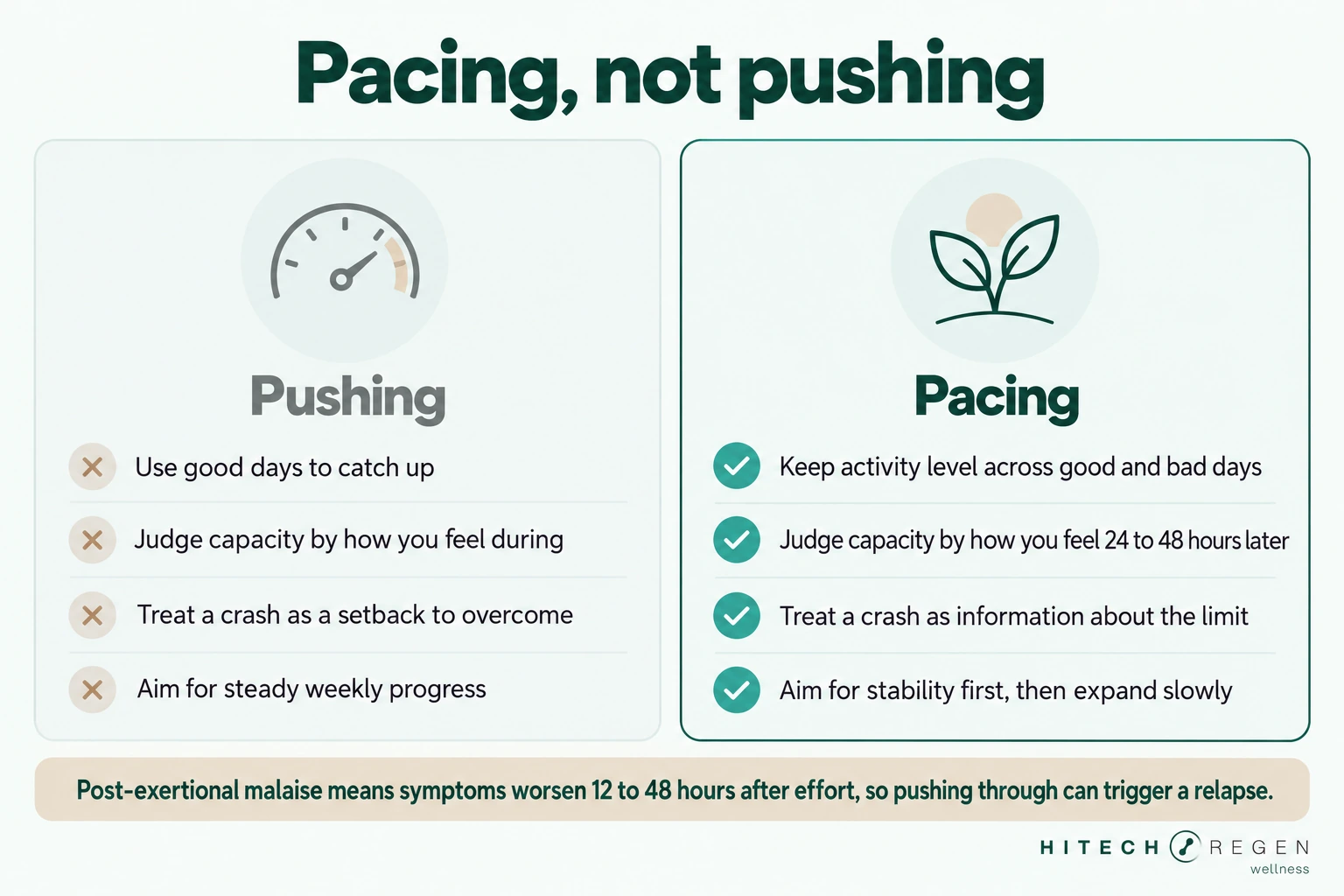
If you take one thing from this page, take this. The CDC defines post-exertional malaise as the worsening of symptoms following even minor physical or mental exertion that would have been tolerated previously, and notes that symptoms typically worsen 12 to 48 hours after the activity.
That delay is what makes it so easy to get wrong. The crash does not arrive during the walk or the meeting. It arrives the next day or the day after, which breaks the feedback loop people normally rely on to judge how much they can do. Someone has a reasonable day, does more, feels fine, and is flattened 36 hours later without connecting the two.
The CDC is direct about the response: post-exertional malaise can be mitigated by activity management, known as pacing, and in general patients should not push themselves beyond their capacities as this may exacerbate symptoms and trigger post-exertional malaise. It describes staying within those limits as staying within the energy envelope, and warns specifically about push and crash cycles, noting that this pushing can lead to relapse.
This runs directly against the usual wellness advice to exercise your way out of fatigue. Where post-exertional malaise is present, graded exercise can make things worse rather than better. Any provider who responds to long COVID fatigue by prescribing a progressive exercise program without first establishing whether you have post-exertional malaise is working from the wrong playbook.
| Pushing | Pacing |
|---|---|
| Use good days to catch up on everything that slipped. | Keep activity roughly level across good and bad days. |
| Judge capacity by how you feel during the activity. | Judge capacity by how you feel 24 to 48 hours afterwards. |
| Treat a crash as a setback to be overcome with more effort. | Treat a crash as information about where the limit currently sits. |
| Add physical and mental load at the same time. | Count mental exertion as exertion, because it triggers the same response. |
| Aim for steady weekly progress. | Aim for stability first, then expand the envelope slowly from there. |
What the research says is happening
The mechanism is not settled, and anyone telling you otherwise is ahead of the evidence. Several lines of investigation are active, and they are not mutually exclusive.
Neuroinflammation is the most discussed. A review published on PubMed Central under the title Long Covid brain fog: a neuroinflammation phenomenon? sets out the case that immune activation affecting the brain could account for the cognitive picture. Other work has examined disruption of the blood-brain barrier in people with cognitive symptoms after COVID, alongside hypotheses involving persistent viral material, microclotting, autonomic dysfunction and reactivation of other viruses.
The National Institutes of Health runs the RECOVER initiative specifically to answer these questions, and its existence is itself a useful signal: the mechanism is considered an open research question at national scale, not something a single clinic has solved.
What this means practically is that treatment in 2026 is symptom-led rather than mechanism-led. That is less satisfying than a single explanation, and it is the accurate position.
What actually helps
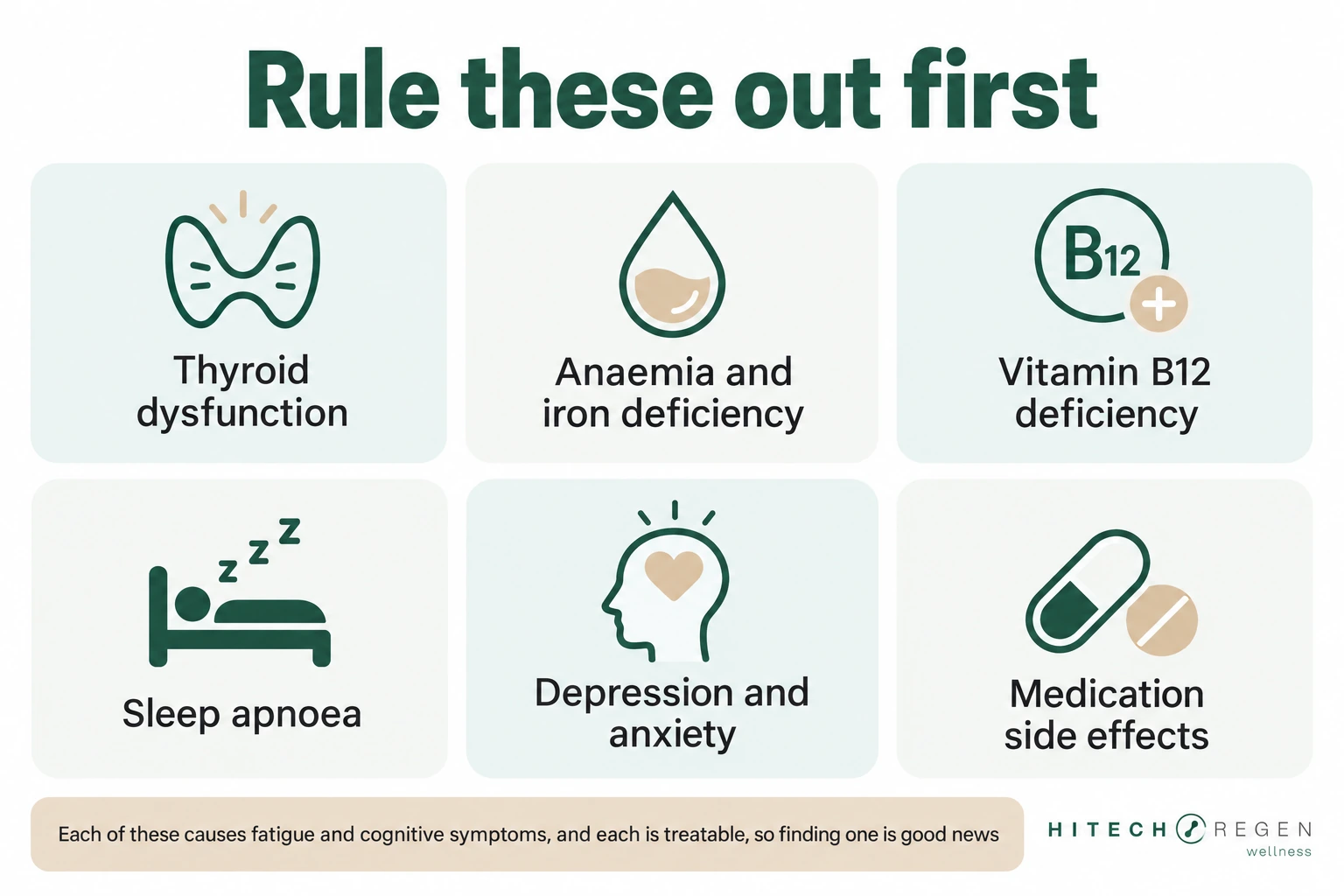
The first step is not a treatment at all. It is ruling out the other things that produce identical symptoms, because several of them are straightforwardly treatable. Thyroid dysfunction, anaemia and iron deficiency, vitamin B12 deficiency, sleep apnoea, depression and anxiety, and medication side effects all cause fatigue and cognitive symptoms. Any serious assessment starts there, and finding one of them is good news rather than a dead end.
Beyond that, the management that has support is unglamorous: pacing built around post-exertional malaise, sleep that is actively protected rather than assumed, treatment of any autonomic symptoms such as a racing heart on standing, cognitive strategies that reduce load rather than train it harder, and gradual, carefully monitored reconditioning only where post-exertional malaise is absent or has settled.
A long COVID clinic or a physician experienced with infection-associated chronic conditions is the right place for this. The CDC notes that people with ME/CFS and other infection-associated chronic conditions frequently struggle to be believed by family, friends and healthcare providers, and to get a diagnosis at all. Finding a clinician who takes the condition seriously is a practical step, not a soft one.
Where supportive and regenerative care honestly sits
People who have been through the assessments and are still unwell reasonably ask what else exists, and the market has answers that run well ahead of the evidence.
There is no approved cell therapy for long COVID in the United States. Studies of cell-based approaches in post-COVID conditions are early, small and designed around safety rather than benefit. The FDA states that there are currently no FDA-approved exosome products and has issued a public safety notification after serious adverse events in patients treated with unapproved products marketed as containing exosomes. Any provider offering to cure long COVID, clear brain fog permanently or reverse the condition is describing something no published evidence supports, and the vulnerability of this patient group makes those claims particularly worth refusing.
What can be discussed honestly is supportive care framed around energy, sleep quality and general wellbeing rather than around curing the condition, kept alongside medical care rather than instead of it, and stopped if it is not helping. Our guide to NMN and NAD+ covers what is and is not established about metabolic support, and our comparison of exosomes, stem cells and PRP sets out the differences between the main approaches.
One caution specific to this condition. Any supportive protocol that involves more activity, more stimulation or a demanding schedule of appointments can itself trigger post-exertional malaise. The energy cost of attending is part of the decision, which is one reason care delivered at home suits this group better than most.
How Hitech Regen approaches long COVID
Hitech Regen provides physician-guided regenerative supportive care across Southern California, delivered in your home. For people whose symptoms are worsened by exertion, not having to travel to an appointment is not a convenience. It is the difference between a session that costs a day of recovery and one that does not.
We are not a long COVID clinic and we do not diagnose or manage the condition. We do not replace the physician coordinating your care, and we will say plainly when the honest answer is that the evidence does not support what you are asking about. What we do is screen carefully, describe investigational options as investigational, and decline people we cannot help. Options span NAD+ therapy as metabolic support, exosome therapy and cell-based protocols. You can read more on our longevity and vitality page, or book a consultation if you want that conversation.
Frequently asked questions
How long does COVID brain fog last?
The CDC reports that most people with long COVID symptoms see significant improvement after 3 months, while others may not improve until months or even years later. Brain fog follows that general pattern and usually fluctuates rather than lifting all at once. If it is still affecting work or daily life past three months, that is the point to seek a formal assessment.
Is COVID brain damage reversible?
Most people with cognitive symptoms after COVID improve, which argues against permanent structural damage as the usual explanation. The mechanisms under investigation, including neuroinflammation and blood-brain barrier disruption, are processes that can settle. Recovery is often slow and uneven, and a minority have a prolonged course, so improvement should not be assumed to mean quick.
Why do I feel worse the day after doing more?
That is post-exertional malaise, which the CDC defines as symptoms worsening after even minor physical or mental exertion that was previously tolerated, typically 12 to 48 hours afterwards. The delay makes it hard to spot. Tracking what you did against how you felt two days later usually makes the pattern obvious.
Should I exercise to get over long COVID fatigue?
Not before establishing whether you have post-exertional malaise. Where it is present, pushing beyond your capacity can exacerbate symptoms and trigger relapse, and the CDC advises activity management rather than pushing. Reconditioning has a place later, carefully monitored, once symptoms are stable. This is a decision to make with a clinician who understands the condition.
What is the energy envelope?
It is the term the CDC uses for the level of activity you can sustain without triggering a crash. Staying inside it means keeping output roughly level rather than spending good days catching up, and counting mental effort as effort. The aim is stability first, then expanding the envelope gradually from a stable base.
What should be ruled out before blaming long COVID?
Thyroid dysfunction, anaemia and iron deficiency, vitamin B12 deficiency, sleep apnoea, depression and anxiety, and medication side effects all produce fatigue and cognitive symptoms. Each is treatable, so finding one is a good outcome. A proper assessment screens for them before attributing everything to long COVID.
Is there a treatment that cures long COVID?
No. Management in 2026 is symptom-led, and no approved cell therapy exists for the condition in the United States. The FDA states there are currently no FDA-approved exosome products and has warned about unapproved ones. Treat any promise to cure long COVID or permanently clear brain fog as a reason to look elsewhere.
Want an honest answer rather than a promise?
Take the two-minute screening and we will tell you whether supportive care has anything to offer alongside your medical care, or whether it does not. We would rather turn someone away than sell a course of treatment to someone the evidence says we cannot help.
Physician-guided care at home, which matters when travel itself costs you a day. Quotes in writing.