
Exosomes for Hair Loss: How It Works, Results, and Cost

Exosome therapy for hair loss uses tiny signalling packets released by stem cells, applied to the scalp in an in-office procedure, with the aim of supporting the environment around hair follicles rather than replacing them. Published clinical studies report measurable increases in hair density and thickness, but the evidence base is small, mostly non-randomised, and no exosome product is approved by the FDA for any use.
That last sentence is the one most pages about this treatment leave out, and it should shape how you read everything else. This guide covers what the therapy involves, what the published studies actually measured, how it compares with PRP and with the established medical options, what drives the cost, and who is a sensible candidate. It supports our hair restoration page.
What exosomes are, and why hair
Exosomes are extracellular vesicles, packets roughly a ten thousandth of a millimetre across, that cells release to communicate with one another. They carry proteins, lipids and genetic messengers such as microRNA. When a mesenchymal stem cell influences the tissue around it, much of that influence travels in these packets rather than through the cell itself, which is the central idea behind cell-free regenerative approaches.
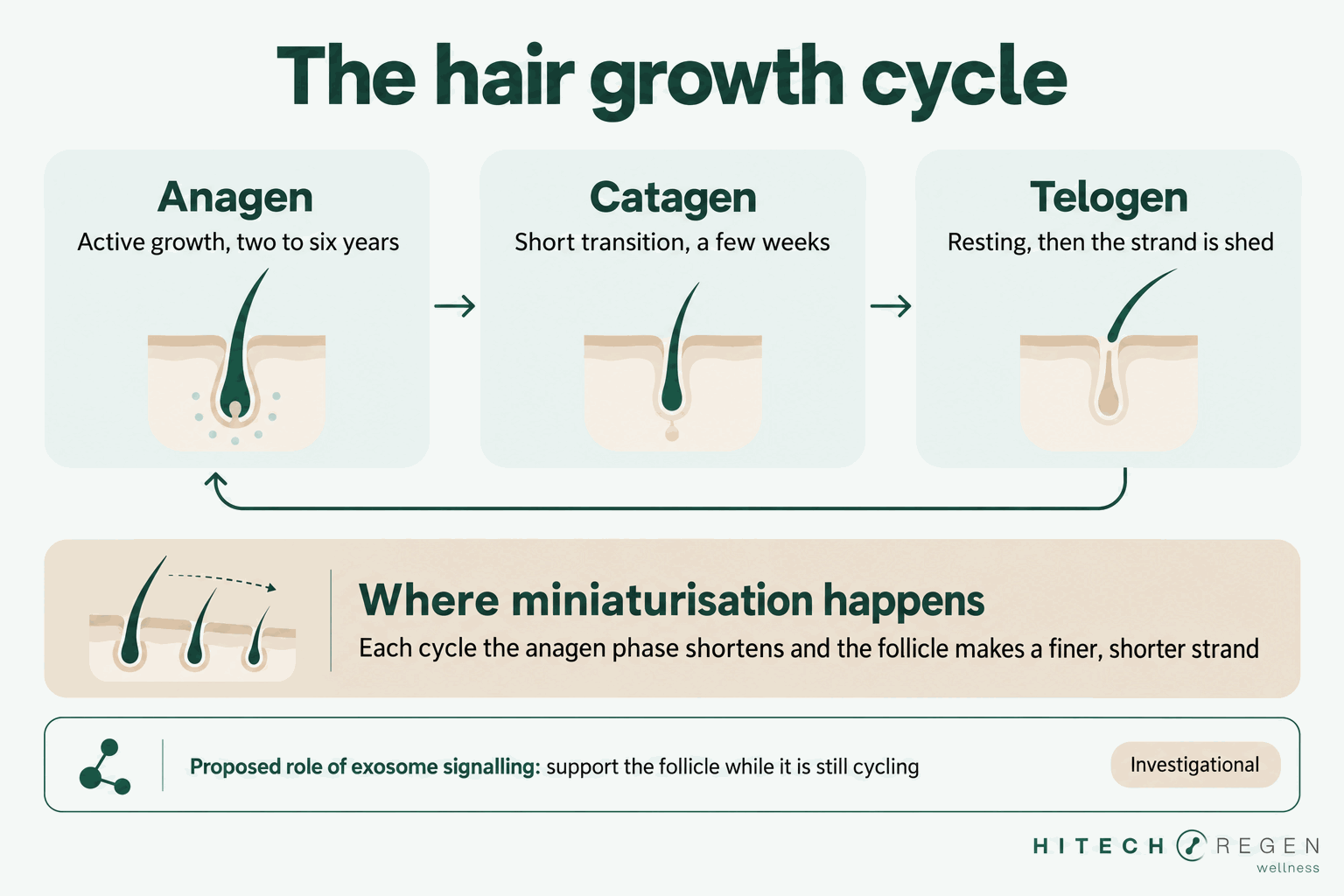
Hair follicles are an appealing target because they are not static. A follicle cycles between growing, regressing and resting phases throughout life, and in pattern hair loss the growing phase shortens while follicles progressively miniaturise. The research question is whether the growth factors and signalling molecules carried in exosomes can influence that cycle, supporting follicles that are still present but underperforming. Note the limit built into that idea: signalling can only act on follicles that exist. Where the follicle is gone, nothing in this category brings it back.
What a session actually involves
The scalp is cleansed and usually numbed with a topical anaesthetic. The exosome preparation is then delivered into the upper layers of the scalp across the treatment area, commonly with microneedling, which creates controlled micro-channels and is itself a recognised stimulus for hair growth. A session typically takes under an hour, and most people return to normal activities the same day, with some redness or tenderness for a day or two.
Protocols vary widely between providers, and that variation is a genuine problem rather than a detail. There is no standardised dose, no standard number of sessions and no agreed source material, which is one of the specific limitations the published reviews call out. Expect a provider to tell you exactly what preparation they use, where it comes from and how many sessions they are recommending before you agree to anything.
How it compares with the alternatives
| Approach | What it does | Evidence position | Who it tends to suit |
|---|---|---|---|
| Minoxidil and finasteride | Prolongs the growth phase and, for finasteride, reduces the hormone driving miniaturisation | FDA approved for pattern hair loss, with the largest and longest evidence base | Almost everyone with pattern hair loss, as the foundation |
| PRP | Concentrates your own platelets and growth factors and returns them to the scalp | Studied for over a decade with mixed but generally supportive results, and no FDA approval for hair loss | People wanting an autologous option with a longer track record |
| Exosome therapy | Delivers cell-derived signalling vesicles to the scalp | 11 clinical studies and 298 patients in a 2025 systematic review, only 2 of them randomised | People with existing but underperforming follicles, willing to accept investigational status |
| Hair transplant | Physically relocates follicles from donor areas | Established surgical procedure with predictable, permanent redistribution | People with defined loss and a good donor area |
The useful way to read that table is that these are not competitors. Medical therapy is the foundation, procedures such as PRP or exosomes are adjuncts to it, and a transplant addresses what neither can. We set out the differences between the regenerative options in more depth in our comparison of exosomes, stem cells and PRP.
Want to know whether your hair loss is the type this can help?
It depends on how many follicles you still have, what is driving the loss, and what else you have tried. Our two-minute screening is the fastest way to find out whether this is worth a physician conversation, or whether something more established should come first.
Physician-guided. Written quotes, no pressure. Serving Southern California at home.
What the clinical evidence actually shows
The most useful single reference is a 2025 systematic review by Al Ameer and colleagues in Clinical, Cosmetic and Investigational Dermatology, which pooled the clinical evidence for exosomes in hair regeneration across alopecia types and exosome sources.
It included 11 clinical studies covering 298 patients in total. Reported hair density improvements varied by the source of the exosomes: placenta-derived preparations were associated with density moving from roughly 96.5 to 163.5 hairs per square centimetre, hair-follicle-derived preparations with increases of about 28 to 30 hairs per square centimetre, and adipose-derived preparations with increases of up to 35 hairs per square centimetre. Hair thickness increases of up to 13.01 micrometres were reported. Sources studied included adipose tissue, placenta, hair follicles, bone marrow, umbilical cord and even plant-derived preparations.
Those are real numbers, and they deserve real caveats, which the authors state themselves. Only two of the eleven studies were randomised controlled trials. The rest were non-randomised, single-arm, retrospective or case reports. The review explicitly cites heterogeneity between studies, small sample sizes and varying follow up durations, and the absence of standardised dosing, frequency and administration methods. Two hundred and ninety eight patients across eleven differently designed studies is a promising signal, not a settled answer, and anyone quoting a single percentage improvement to you is quoting one small study as though it were the field.
The regulatory position, stated plainly
The FDA issued a Public Safety Notification on exosome products in December 2019 and it still stands. The agency states that there are currently no FDA-approved exosome products, and that exosomes used to treat conditions in humans are regulated as drugs and biological products requiring approval. The notification was prompted by multiple reports of serious adverse events in patients in Nebraska treated with unapproved products marketed as containing exosomes.
The FDA also tells consumers what to ask: whether the product is being studied under an Investigational New Drug application, what the actual facts are, and to read the consent form properly. Those are good questions, and a provider who is uncomfortable answering them has told you something useful. We would rather you read that notification before your consultation than after it.
What it costs, and why published prices vary so much
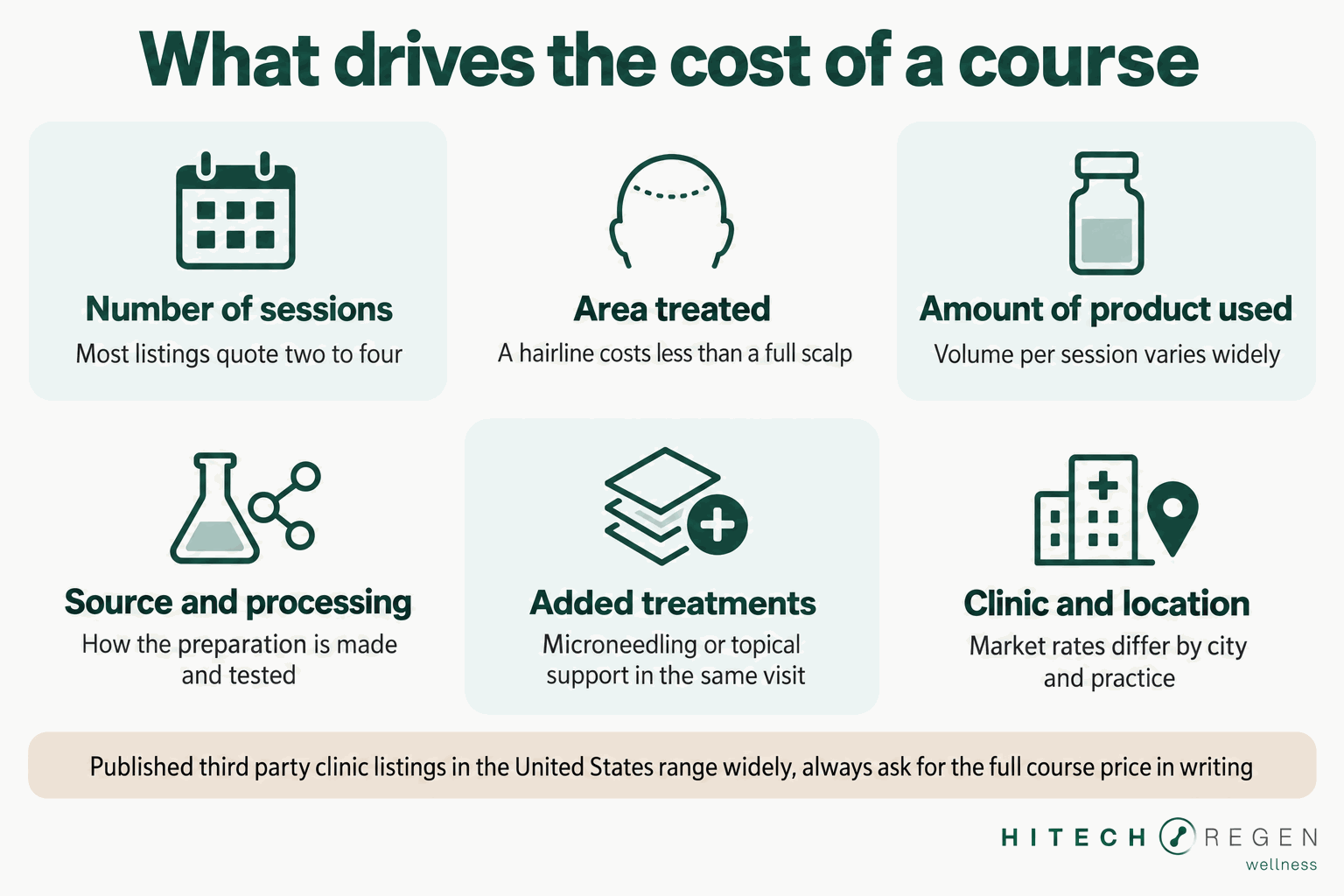
Published clinic listings in the United States commonly report exosome hair therapy at roughly $2,500 to $6,000 per session, with two to four sessions spread over six to twelve months. Other listings quote $3,000 to $10,000 for a whole course. Those figures are market context gathered from third party clinic pricing pages, not Hitech Regen pricing, and the gap between them is the point rather than a rounding error.
Prices differ that widely because the listings are not describing the same thing. The variables that actually move the number are the source and volume of the preparation, whether the lab supplying it is accredited and publishes its characterisation data, whether microneedling and other adjuncts are bundled or billed separately, how many sessions the protocol involves, who performs it, and whether maintenance is included or sold later. Insurance does not cover any of it, because the treatment is cosmetic and investigational.
A quote that is dramatically below the range is usually telling you something about the preparation rather than about how generous the clinic is. The same logic we set out for stem cell therapy costs applies here. Ask what the price includes, in writing, before comparing two numbers.
Who is a reasonable candidate, and who is not
Screening generally favours people with early to moderate pattern hair loss who still have visible miniaturised hair in the thinning area, who have a diagnosis rather than an assumption about what is causing it, and whose expectations are framed around density and thickness rather than a restored hairline.
It generally excludes people with long-standing complete loss in an area, active scalp infection or inflammatory scalp disease, untreated thyroid or iron deficiency driving the loss, and anyone expecting a permanent result from a course of sessions. If your hair loss has never actually been diagnosed, the first appointment worth booking is with a dermatologist, not with us.
How Hitech Regen approaches it
Hitech Regen provides physician-guided regenerative supportive care across Southern California, delivered in your home. Every plan starts with a health history review and a frank conversation about evidence and expectations.
For hair specifically, that means saying clearly that this is investigational, that established medical therapy is the foundation and not something to abandon, and that we would rather turn someone away than sell a course to a scalp that will not respond to it. Options span exosome therapy and cell-based protocols. You can read more on our aesthetic and recovery page, or book a consultation for a written quote.
Frequently asked questions
Do exosomes really work for hair loss?
Published studies report measurable gains in hair density and thickness, but the evidence base is small. A 2025 systematic review found 11 clinical studies covering 298 patients, only two of them randomised controlled trials, with no standardised dosing or protocol. It is a promising signal rather than a proven treatment.
Is exosome therapy FDA approved for hair loss?
No. The FDA states there are currently no FDA-approved exosome products for any use, and regulates exosomes used to treat conditions in humans as drugs and biological products. Its Public Safety Notification on exosome products remains in force and is worth reading before any consultation.
How long before you see results?
Hair grows slowly, so nothing is visible quickly. Studies generally assess outcomes at three to six months, and protocols spread sessions over six to twelve months for that reason. Anyone promising a visible change in weeks is describing shedding patterns, not regrowth.
How does it compare with PRP?
PRP uses your own platelets and has a longer clinical track record, though it is also not FDA approved for hair loss. Exosome preparations are cell-derived and come from an outside source. Neither is established enough to displace medical therapy, and the sensible comparison is which suits your situation, not which is superior.
How much does exosome hair therapy cost?
Published clinic listings commonly report roughly $2,500 to $6,000 per session, with two to four sessions typical, though quoted figures vary widely because they cover different things. That is market context rather than our pricing. Book a consultation for a written quote for your situation.
Will I need to keep having sessions?
Probably. Pattern hair loss is driven by an ongoing process, so any adjunct that supports follicles is working against a continuing pressure. Treat maintenance as part of the cost of the decision rather than as a surprise later, and ask specifically whether it is included.
Should I stop minoxidil or finasteride if I try this?
No, and not without asking the physician who prescribed them. Those are the FDA approved foundation of pattern hair loss treatment with the strongest evidence behind them. Adjunct procedures are meant to sit alongside that foundation, never to replace it.
Get an honest answer before you spend anything
Two minutes of screening will tell you whether your hair loss is the kind this can support, or whether your money is better spent elsewhere first. If it is the second, we will say so.
Physician-guided care at home. Written quotes, and a straight answer about what the evidence supports.