
Microneedling with Exosomes: Before and After, Cost, and What to Expect

Microneedling with exosomes is a two-part procedure: a device creates controlled micro-channels in the skin, and an exosome preparation is applied topically so it can pass through those channels into the upper layers. The microneedling itself is a long-established procedure with a device clearance behind it. The exosome half is investigational, and the published evidence supporting the combination is far thinner than the marketing around it suggests.
That gap between how heavily the treatment is promoted and how little has actually been published is the single most useful thing to understand before booking one. This guide covers what a session involves, what the systematic review of this exact combination found, how to read before and after photos honestly, how it compares with PRP, what published listings charge, and where the FDA stands. It pairs with our aesthetic recovery page.
What a session actually involves
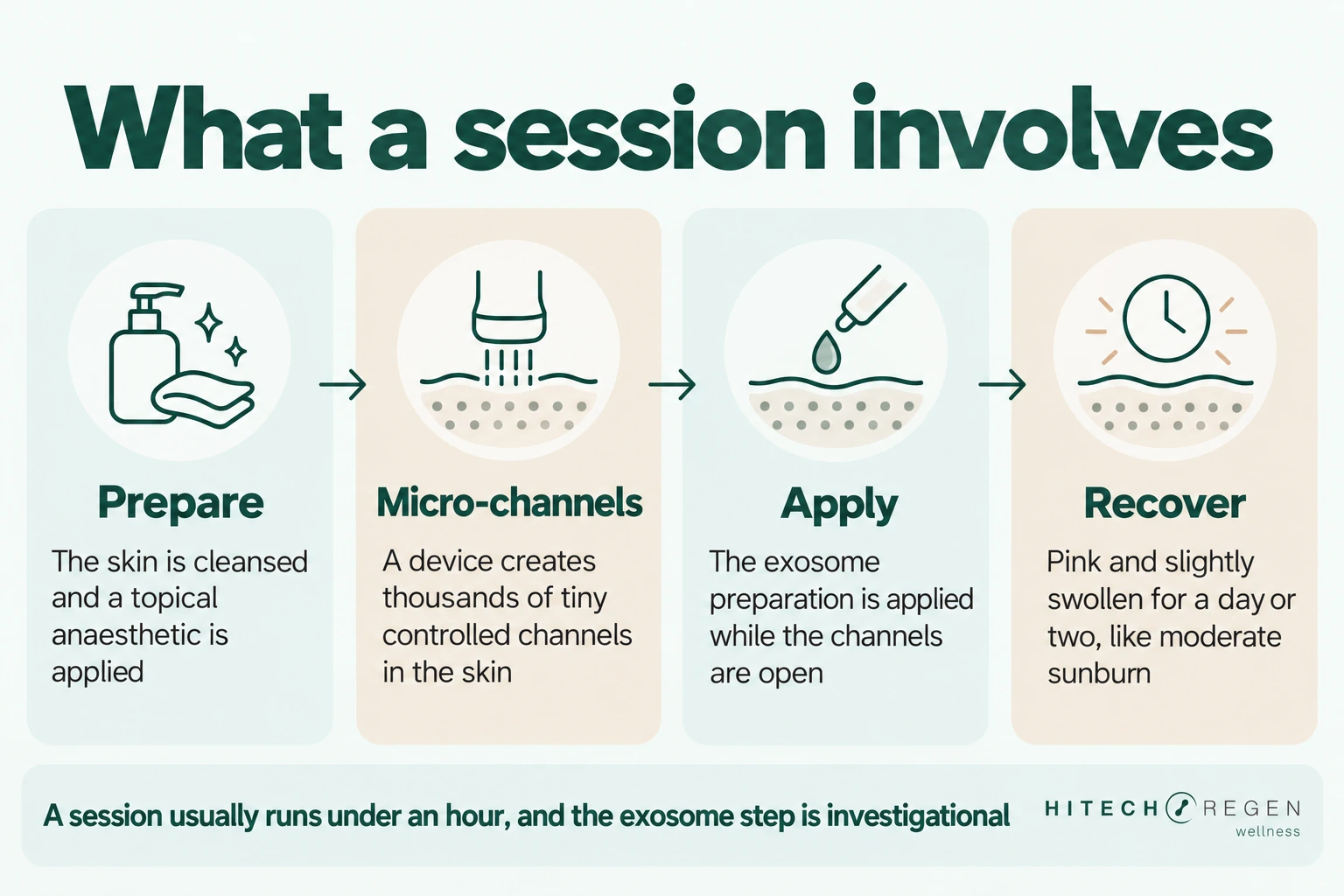
Microneedling, also called percutaneous collagen induction therapy, works by creating thousands of tiny controlled punctures in the skin. The wound-healing response that follows is the active ingredient: the skin lays down new collagen as it repairs, which is why the procedure has been used for scarring, texture and fine lines for years in its own right.
The exosome step adds a topical preparation applied during and after the passes, while the channels are still open. Exosomes are small vesicles that cells release and that carry signalling material between cells. The proposition is that applying them at the moment of controlled injury nudges the healing response in a more productive direction. That proposition is biologically reasonable and, as the next section sets out, not yet well evidenced in humans.
In practice a session usually runs under an hour. The skin is cleansed and a topical anaesthetic is applied, the device is passed over the treatment area at a depth chosen for the concern being treated, and the preparation is applied. Most people are pink and slightly swollen for a day or two, similar to moderate sunburn, and return to normal activities the same day or the next.
What the evidence actually shows
In 2026, Dhaliwal and colleagues published a systematic review in the Journal of Cosmetic Dermatology titled The Use of Microneedling With Exosomes in Dermatology. It is the most direct answer available to the question of whether this combination works, and its numbers deserve to be read carefully.
| The review at a glance | Finding |
|---|---|
| References screened | 256 unique references identified |
| Studies eligible after appraisal | 10, of which 8 were included in the final narrative synthesis |
| Sample sizes | Between 3 and 60 participants per study |
| Conditions covered | Androgenetic alopecia, skin aging, hyperpigmentation, active scarring, enlarged pores |
| Method | PRISMA reporting guidance, synthesis without meta-analysis, registered with PROSPERO |
| Authors conclusion | Promising across a range of conditions, but more evidence is required before the safety and efficacy profiles can be established |
Eight studies with between 3 and 60 people in each is a small evidence base for a procedure sold in thousands of clinics. The authors are explicit that longer follow-up periods and larger sample sizes are necessary to determine the long-term safety profile as well as the effectiveness of the treatment. Note that safety and effectiveness are both named as open questions, not just effectiveness.
None of this means the procedure does nothing. It means that anyone presenting it as an established, proven treatment is going beyond what has been published, and that a clinic willing to tell you this is giving you better information than one that is not.
Want a straight read on whether this suits your skin?
A procedure with an evidence base this early deserves a careful conversation rather than a booking form. Our two-minute screening asks what you are actually trying to change and what you have already tried, and tells you whether a conversation with our physician is worth your time. If microneedling alone would do the same job, we will say so.
Physician-guided. Written quotes, no pressure. Serving Southern California at home.
Before and after photos, and how to read them
Before and after galleries are the most searched part of this topic and the least reliable. A few habits make them far more useful.
Check the lighting and the angle first. Skin texture is almost entirely a function of how light falls across it, so a harder side light in the before photo and a softer front light in the after photo will produce a dramatic difference with no change in the skin at all. Look at whether the same light source sits in the same position in both frames.
Then check the expression and the makeup. Relaxed versus slightly lifted brows changes forehead lines. Any base makeup in the after photo invalidates a texture comparison entirely. Then check the interval: collagen remodelling after microneedling continues for weeks, so a photo taken at two weeks and one taken at three months are measuring different things.
Finally, ask what else was done. Many galleries labelled as exosome microneedling show results from a course of several sessions, sometimes combined with radiofrequency microneedling, resurfacing or a skincare protocol run alongside. That is a reasonable way to treat skin, but it does not isolate what the exosomes contributed, and neither does any study published so far.
We do not publish patient before and after galleries, because a photograph taken under conditions we control is not evidence, and we would rather point you to what has actually been measured.
Exosomes or PRP with microneedling
This is the most common comparison question, and the honest answer is that they sit at different points on the evidence curve rather than one simply beating the other.
| Exosome preparation | PRP | |
|---|---|---|
| What it is | Vesicles carrying cell signalling material, from an outside source | A concentrate prepared from a sample of your own blood on the day |
| Source | A manufactured product, with composition that varies between suppliers | Autologous, so it comes from you and nothing is introduced from outside |
| Regulatory position | No FDA-approved exosome products exist | Widely used, with the preparation devices themselves cleared |
| Evidence base | 8 studies, 3 to 60 participants each, per the 2026 systematic review | Larger and longer-running literature, though results vary by indication |
| Practical differences | No blood draw, no preparation time, consistent batch to batch within a supplier | Requires a blood draw and processing time, and quality depends on your own blood |
| Cost position | Typically the more expensive of the two | Typically the less expensive of the two |
The practical reading: PRP has the longer track record and the advantage of using your own material, while exosome preparations are more convenient and newer. If a clinic tells you exosomes are simply better, ask what they are comparing against and on what published basis. We cover the wider comparison in our guide to exosomes, stem cells and PRP.
What it costs
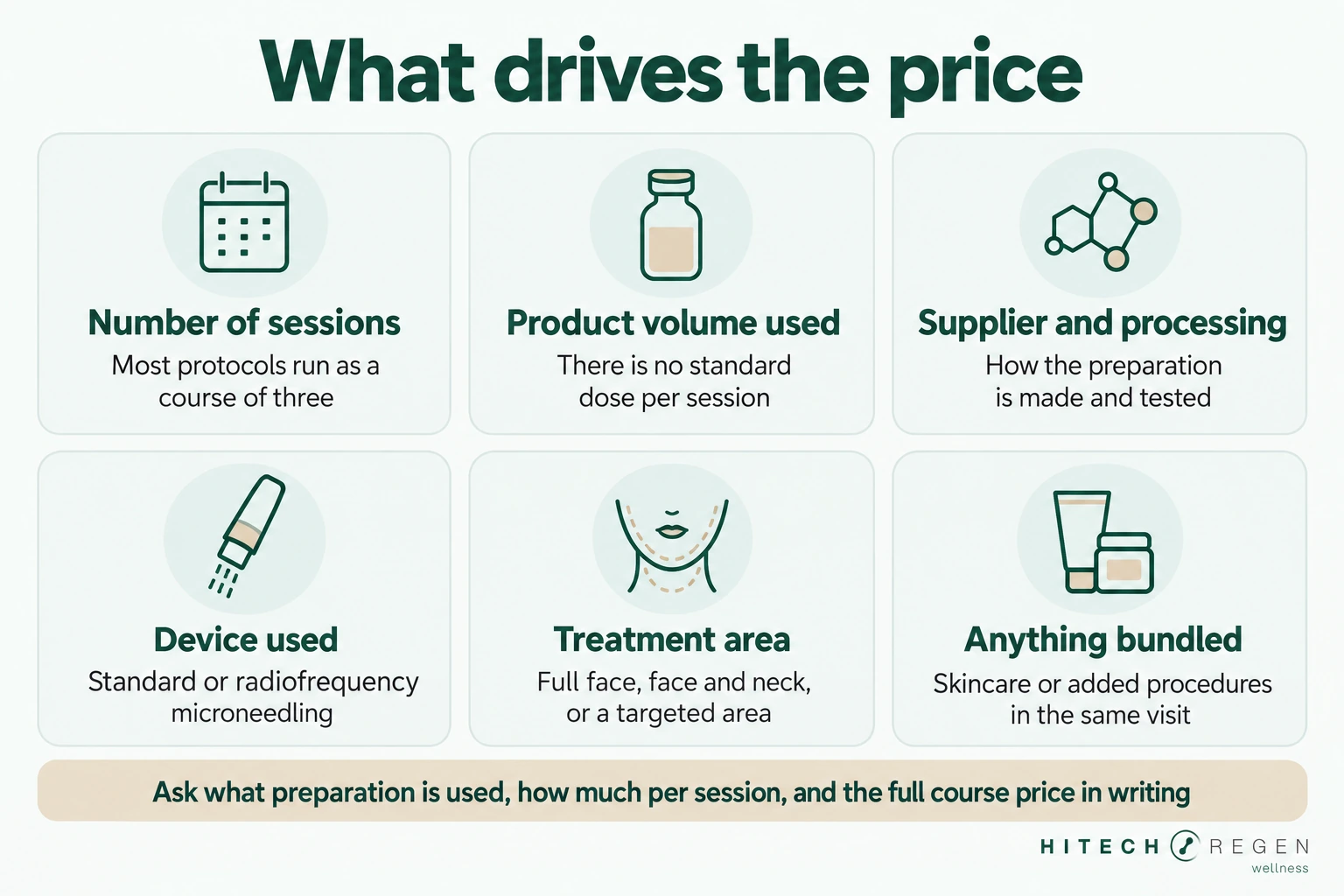
Published clinic listings in the United States commonly start around 550 dollars for a single session and rise well beyond that once radiofrequency microneedling, larger treatment areas or greater product volumes are involved. Most listings quote a course of three sessions rather than a single visit. Those are third-party market figures offered as context, not Hitech Regen pricing.
The spread is wide, and the reason is worth understanding rather than shopping past. There is no standardised exosome product, so two clinics advertising the same procedure name may be applying materially different preparations in different quantities. Price differences often reflect that rather than reflecting service quality.
| What drives the price | Why it moves the number |
|---|---|
| Number of sessions | Most protocols run as a course of three, so the course price is the figure that matters, not the per-session one. |
| Product volume used | There is no standard dose. A clinic using more product per session will cost more and should be able to say how much it uses. |
| Supplier and processing | Preparations differ in source and in how they are processed and tested, and that cost is passed on. |
| Device used | Standard microneedling and radiofrequency microneedling are different procedures at different price points. |
| Treatment area | A full face, a face and neck, or a targeted area such as the under-eyes are priced differently. |
| Anything bundled | Skincare protocols or added procedures in the same visit are frequently included in a quoted package price. |
The single most useful question to ask any clinic is what preparation they use, how much of it per session, and what the full course costs in writing. A provider who cannot answer the first two is not in a position to tell you what you are buying.
Safety, side effects and the FDA position
The microneedling side has the ordinary and well-characterised risks of the procedure: redness, swelling, pinpoint bleeding, temporary sensitivity, and a small risk of infection or pigment change, higher in darker skin tones and higher still if aftercare is poor. These usually settle within days.
The exosome side carries a regulatory position that every patient should hear before booking. The FDA states plainly that there are currently no FDA-approved exosome products. The agency issued a public safety notification after multiple reports of serious adverse events in patients treated with unapproved products marketed as containing exosomes, reported to it with the involvement of the Centers for Disease Control and Prevention. The point is not that exosome preparations are inherently dangerous. It is that no outside body has verified what is in any given product, so the supplier and the provider are the only quality control in the chain.
That is also the honest answer to the question people ask most nervously. Exosomes occur naturally throughout the body and are part of ordinary cell communication, and there is no evidence that cosmetic use of these preparations causes cancer. What is true is that long-term safety data for this specific use does not yet exist, which is exactly why the 2026 systematic review lists the long-term safety profile as an open question alongside effectiveness.
How Hitech Regen approaches it
Hitech Regen provides physician-guided regenerative supportive care across Southern California, delivered in your home. Every candidate is screened by a physician before anything is offered, and part of that screening is telling people when a simpler or better-evidenced option would serve them just as well.
We describe exosome therapy as investigational because that is what it is, and we put quotes in writing so you can see exactly what a course includes before you commit to it. Our guide to exosomes for hair loss covers the scalp application of the same technology, and you can book a consultation when you want a direct conversation about your own skin.
Frequently asked questions
Is microneedling with exosomes better than microneedling alone?
The published evidence is not yet strong enough to say. The 2026 systematic review found eight eligible studies with between 3 and 60 participants each and concluded that more evidence is needed before efficacy can be established. Microneedling on its own has a longer track record, so a reasonable approach is to treat the exosome step as an addition under evaluation rather than a requirement.
Which is better, PRP or exosomes?
Neither is established as better. PRP uses your own blood and has a larger published literature. Exosome preparations come from an outside source, avoid a blood draw, and are newer with a thinner evidence base and no FDA-approved products. The choice usually comes down to evidence preference, convenience and cost rather than a clear clinical winner.
Are microneedling exosomes safe?
The microneedling component has well-characterised short-term risks that usually settle in days. For the exosome component, the 2026 systematic review names the long-term safety profile as still undetermined, and the FDA has reported serious adverse events linked to unapproved exosome products. Ask which preparation a clinic uses and how it is tested.
Are exosomes cancerous?
No evidence shows that cosmetic exosome procedures cause cancer. Exosomes are a normal part of how cells communicate throughout the body. Because research into their signalling role is still developing and long-term data for cosmetic use does not exist, caution and honest disclosure are appropriate, which is why the systematic review lists long-term safety as unresolved.
How often should you have microneedling with exosomes?
Most published clinic protocols run a course of about three sessions spaced several weeks apart, with maintenance afterwards. There is no standardised schedule in the literature, because the studies to establish one have not been done. Spacing should allow the skin to complete its healing response between sessions.
How long do the results last?
Collagen remodelling after microneedling continues for weeks to months, so results typically build rather than appear at once. How long they hold has not been established for the exosome combination, since the published studies had short follow-up. Expect maintenance sessions to be part of any realistic plan.
Does insurance cover it?
No. This is a cosmetic procedure and is not covered by medical insurance. Ask for the full course price in writing rather than a per-session figure, since most protocols involve several sessions and added products or technology change the total considerably.
Get a written quote and an honest assessment
Take the two-minute screening and we will tell you whether this is a reasonable fit for what you are trying to change, what a course would involve, and what it would cost in writing. If a simpler option would get you the same result, that is what we will recommend.
Physician-guided care at home. Investigational options described as investigational, and quotes in writing.