
Small Fiber Neuropathy: Symptoms, Causes, and Treatment Options

Small fiber neuropathy is damage to the smallest nerve endings in the skin, the thinly myelinated A-delta fibers and the unmyelinated C fibers that carry pain, temperature and automatic body functions. It usually shows up as burning, tingling or stabbing pain in the feet that creeps upward over months or years, and it is diagnosed with a skin punch biopsy rather than a standard nerve conduction study, because standard testing is normal in isolated small fiber disease.
That combination, real symptoms with normal routine test results, is why so many people spend years being told nothing is wrong. This guide covers what the condition is, the full symptom picture including the autonomic signs most people never connect to their feet, what actually causes it, how it is properly diagnosed, what treatment can and cannot do today, and what the research says about newer regenerative approaches. It is written for patients, and it pairs with our peripheral neuropathy overview.
What small fiber neuropathy is
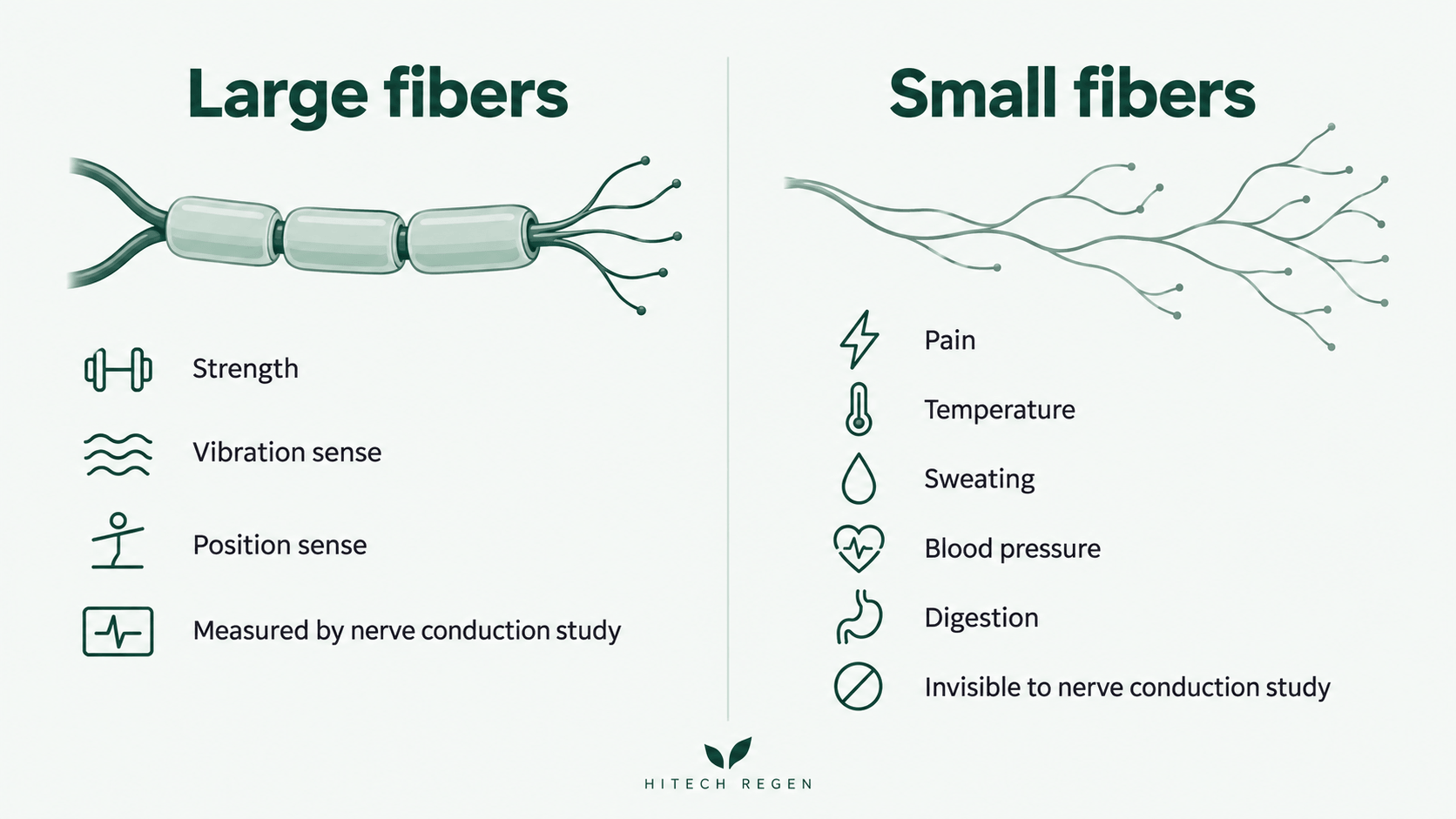
Your peripheral nerves come in two broad sizes. Large fibers handle strength, vibration sense and position sense, and they are what a nerve conduction study measures. Small fibers handle pain, heat and cold, and they also run the automatic systems you never think about: sweating, blood pressure control on standing, heart rate, digestion and bladder function.
Small fiber neuropathy is the selective loss or dysfunction of that second group. Because the large fibers are intact early on, muscle strength and reflexes often look normal in the office, and the nerve conduction study comes back clean. The damage is real, but it sits in nerve endings too fine for that test to see.
The scale is larger than most people expect. StatPearls, the peer reviewed clinical reference hosted by the National Center for Biotechnology Information, notes that peripheral neuropathy of all types affects an estimated 15 to 20 million people in the United States over the age of 40, and cites a Dutch population study that put small fiber neuropathy specifically at roughly 12 new cases per 100,000 per year and a prevalence near 53 cases per 100,000. It is more common in men and in people over 65.
Small fiber neuropathy symptoms
The classic opening symptom is burning pain in both feet, often worse at night and worse when the feet are warm. Many patients describe electric shocks, pins and needles, a feeling of walking on pebbles or sand, or skin so sensitive that a bedsheet hurts. The pattern is typically length dependent, meaning it starts in the longest nerves, at the toes, and spreads upward in a stocking distribution before the hands become involved.
What gets missed is the autonomic half. Because small fibers also run automatic functions, the same condition can produce dry eyes and dry mouth, reduced or excessive sweating, constipation or diarrhea, bladder urgency, lightheadedness on standing, palpitations and sexual dysfunction. Patients rarely mention those to the neurologist looking at their feet, and clinicians who do not ask miss half the picture.
| Symptom group | What patients describe | Why it happens |
|---|---|---|
| Painful sensory | Burning, stabbing, electric shocks, pins and needles, painful response to light touch | Damaged C and A-delta fibers fire spontaneously and misreport normal signals as pain |
| Loss of sensation | Numbness, trouble telling hot water from cold, unnoticed cuts or blisters | The same fibers carry temperature and protective pain signals |
| Autonomic | Dry eyes and mouth, sweating changes, constipation, bladder urgency, dizziness on standing, palpitations | Small fibers also control sweat glands, blood vessels, gut and bladder |
| Knock-on effects | Broken sleep, exhaustion, low mood, reduced walking tolerance | Night-predominant pain and disrupted autonomic regulation |
A less common variant, non length dependent small fiber neuropathy, starts patchily in the face, trunk or thighs instead of the feet. It is more often linked to autoimmune causes, and it is a frequent reason patients get told their symptoms do not fit a pattern.
Recognize your symptoms in that list?
A proper diagnosis comes first, and it belongs with a neurologist. If you already have one and you are asking what supportive options exist alongside it, our two-minute screening tells you whether a physician conversation is worth your time.
Physician-guided. Written quotes, no pressure. Serving Southern California at home.
What causes small fiber neuropathy
Causes fall into a handful of families, and finding the right one changes everything about what happens next, because the single most effective step in nerve care is addressing what is damaging the nerves.
Metabolic. Diabetes is the most common identifiable cause, and the American Society of Regional Anesthesia and Pain Medicine review of small fiber neuropathy names it as such. Importantly, prediabetes and impaired glucose tolerance are also associated with small fiber damage, which is why a normal fasting glucose does not close the question and a glucose tolerance test or HbA1c is part of a thorough workup.
Autoimmune and inflammatory. Sjogren syndrome is a well recognized cause, and connective tissue disease, sarcoidosis and celiac disease all appear in the literature. Autoimmune cases are overrepresented among the patchy, non length dependent presentations.
Nutritional and toxic. Vitamin B12 deficiency, vitamin B6 excess, heavy alcohol use, chemotherapy and certain other medications are established contributors.
Infectious and post-infectious. The ASRA review lists hepatitis C, HIV, Lyme disease, herpes zoster and long COVID among infectious associations.
Genetic. Mutations in the sodium channel genes SCN9A, SCN10A and SCN11A, described on the MedlinePlus Genetics page for small fiber neuropathy, make nerve fibers hyperexcitable. Fabry disease is another inherited cause worth excluding in younger patients.
Idiopathic. Despite a full workup, a substantial share of cases has no identified cause. Idiopathic does not mean imaginary, and it does not mean untreatable. It means the search did not find a target, and that symptom control becomes the main job.
How small fiber neuropathy is diagnosed
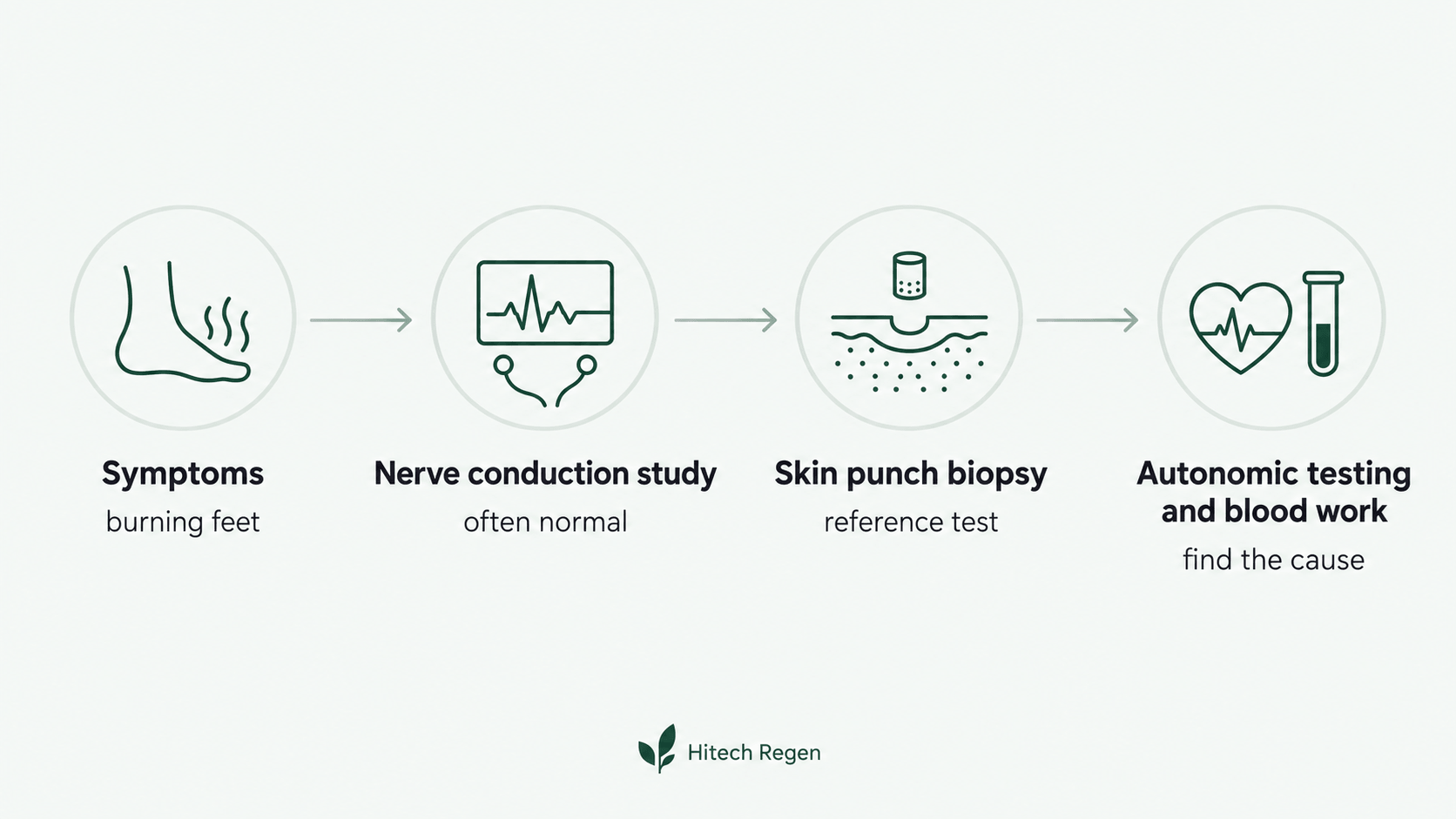
This is where the condition is most often missed. A standard nerve conduction study and electromyography test large fibers, so in pure small fiber neuropathy they come back normal. A normal nerve conduction study does not rule the condition out, and patients are entitled to say so.
The reference test is a skin punch biopsy, usually a small sample taken from the lower leg, which is processed to count intraepidermal nerve fiber density. StatPearls reports a sensitivity of roughly 88 percent for skin biopsy in small fiber neuropathy, and around 80 percent for QSART, the test that measures the sweat response. Current practice recommends making the diagnosis on clinical presentation plus at least two abnormal findings, rather than on one test alone.
| Test | What it measures | What to expect in small fiber neuropathy |
|---|---|---|
| Skin punch biopsy (IENFD) | Density of nerve fibers in the skin | Reduced fiber density; the reference test, about 88 percent sensitivity |
| Nerve conduction study and EMG | Large fiber function | Normal in isolated small fiber disease; used to rule out large fiber involvement |
| QSART and autonomic testing | Sweat response and autonomic nerve function | Often abnormal; sensitivity reported up to about 80 percent |
| Quantitative sensory testing | Thresholds for heat, cold and pain | Abnormal thresholds; supportive, and partly dependent on patient response |
| Blood work | Glucose handling, B12, thyroid, autoimmune and inflammatory markers | Looks for the treatable cause behind the neuropathy |
Small fiber neuropathy treatment options
Treatment runs on two tracks at once, and both matter.
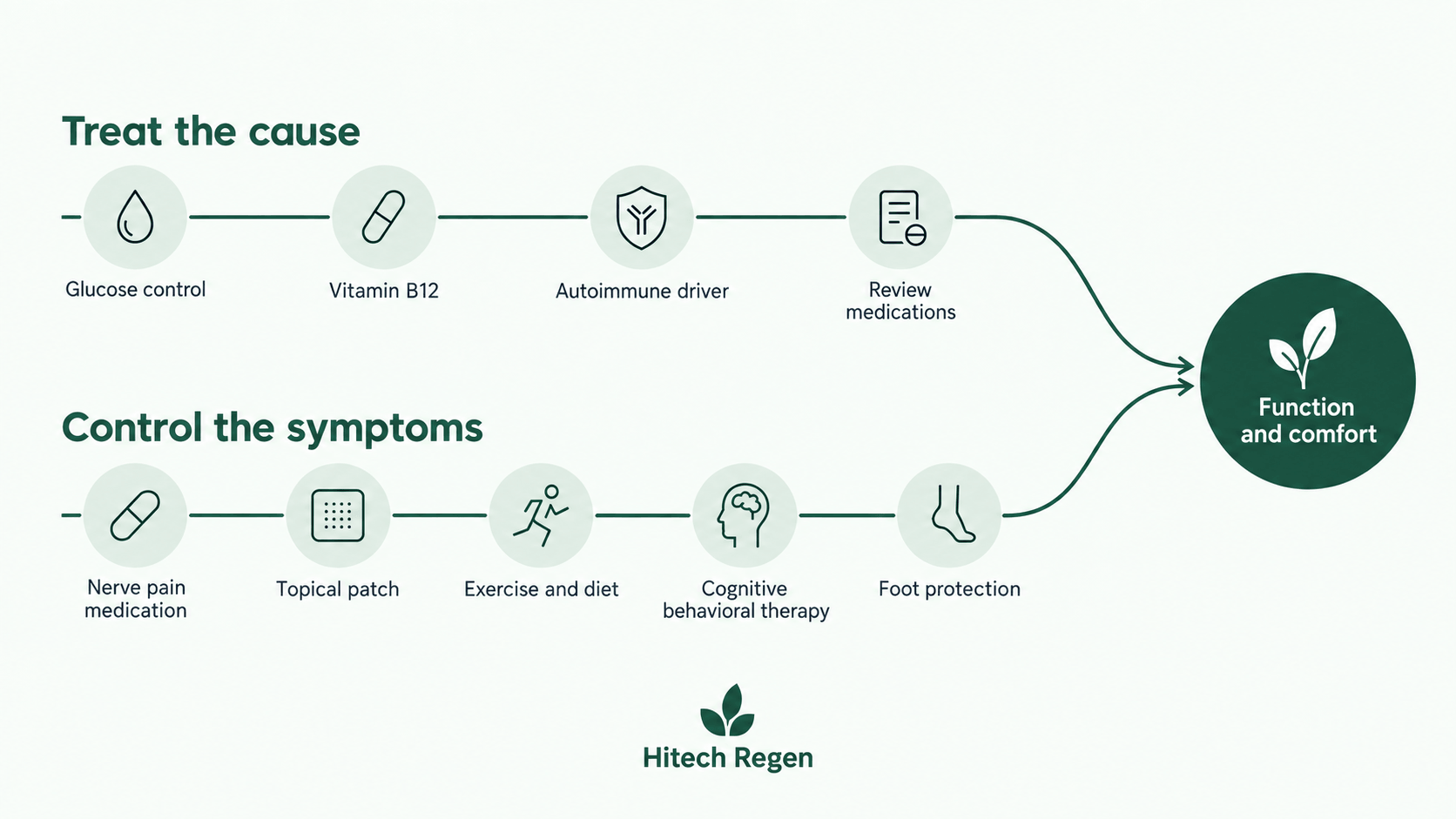
The first track is the cause. Tightening glucose control, correcting a B12 deficiency, treating an autoimmune driver or stopping a contributing medication can slow or halt progression. Nothing else in the plan does that job.
The second track is symptom control. First-line medications named in the StatPearls review include gabapentin, pregabalin, amitriptyline and nortriptyline, and the ASRA review adds duloxetine and venlafaxine. A 5 percent topical lidocaine patch is a common option for a localized area, and both reviews note that combination therapy tends to outperform a single agent. Every one of these has side effects that limit dosing for some people, which is the honest reason many patients end up under-treated and looking for something else.
Non-drug measures carry more weight than they get credit for. The ASRA review lists exercise, dietary change, cognitive behavioral therapy and, for carefully selected refractory cases, spinal cord stimulation. Foot protection and daily skin checks matter whenever temperature and pain sensation are blunted, because an injury you cannot feel is the one that becomes a problem.
Prognosis: life expectancy and whether it can be reversed
Two questions dominate the searches people run after a diagnosis, so here are direct answers.
Small fiber neuropathy is not, in itself, a fatal condition, and it is not typically described as shortening life expectancy. What can affect long-term health is the underlying cause, diabetes being the clearest example, which is another argument for pursuing the cause rather than only the pain.
Progression is usually slow. StatPearls reports that among 124 patients followed for two years, only 13 percent developed signs of large fiber involvement, and over half improved or stayed stable. Nerve fibers can regrow when the driving cause is removed early, which is why prompt evaluation of new burning or tingling matters more here than in many conditions. Longstanding, severe numbness reflects fiber loss that no current therapy is proven to reverse, and any provider who promises otherwise is selling rather than informing.
What the research says about regenerative approaches
Patients whose pain is not controlled by standard care reasonably ask what else exists. Here is the evidence as it actually stands, without the marketing gloss.
Mesenchymal stromal cells are the most studied cell type for neuropathy. The proposed mechanism is not that transplanted cells become new nerves, but that they release growth factors and anti-inflammatory signals that support the environment around damaged nerves. A 2024 systematic review and meta-analysis in the journal Stem Cell Research and Therapy pooled seven controlled human trials covering 400 patients with diabetic peripheral neuropathy and reported modest improvements: motor nerve conduction velocity up by 2.2 meters per second, sensory nerve conduction velocity up by 1.9, and improved vibration perception and clinical scores.
Four honest caveats belong with those numbers. The trials studied diabetic peripheral neuropathy, not small fiber neuropathy specifically. Seven trials and 400 patients is early-stage evidence, not a settled answer. The same authors flag the absence of long-term follow-up and the need to study safety questions systematically. And none of this is FDA approved for neuropathy; the FDA maintains a public consumer warning about unapproved products derived from human cells and tissues, and has taken enforcement action against clinics marketing them with cure claims. Research on exosomes, the signaling vesicles these cells release, follows the same logic and sits at an even earlier stage, which we walk through in our comparison of exosomes, stem cells and PRP.
The reasonable conclusion is neither dismissal nor enthusiasm. Cell-based approaches are investigational supportive care that some patients choose to explore alongside neurological treatment, with realistic goals around comfort and function, and with clear eyes about what the evidence does and does not show.
How Hitech Regen approaches nerve-related concerns
Hitech Regen provides physician-guided regenerative supportive care across Southern California, delivered in your home, which is a practical point when painful feet make travel to appointments its own obstacle. We are not a neurology practice, we do not diagnose neuropathy, and we do not replace the physician managing your care.
What we do is screen carefully and speak plainly. Every plan starts with a health-history review and a candid conversation about what the evidence supports, and options span cell-based protocols, exosome therapy and NAD+ therapy as metabolic support. If your underlying cause is not being managed, or if your goals are not realistic, the right answer is to say so, and we do. You can read more about the conditions we support on our neurological support page, and you can book a consultation whenever you want that conversation.
Frequently asked questions
What are the first symptoms of small fiber neuropathy?
Burning, tingling or prickling in both feet, often worse at night, is the usual first symptom. Some people notice trouble telling hot from cold, or skin that hurts at light touch. Autonomic signs such as dry eyes, dry mouth or dizziness on standing can appear early and are often not connected to the feet.
Is small fiber neuropathy permanent?
Not always. When the underlying cause is found and addressed early, nerve fibers can recover to a degree, and clinical follow-up shows most patients stay stable or improve over two years. Longstanding severe numbness reflects fiber loss that current therapies are not proven to reverse, so early evaluation matters.
Can you die from small fiber neuropathy?
Small fiber neuropathy is not itself considered a fatal condition and is not typically described as shortening life expectancy. The underlying cause can carry its own health risks, diabetes most commonly, which is why identifying and managing that cause is the central part of care rather than an optional extra.
How do you treat small fiber neuropathy?
Treatment addresses the cause and the symptoms together. Clinical reviews list gabapentin, pregabalin, duloxetine and tricyclic antidepressants as first-line for nerve pain, with a topical lidocaine patch for localized areas and combination therapy often outperforming one drug. Exercise, dietary change and cognitive behavioral therapy are established supports.
What autoimmune disease causes small fiber neuropathy?
Sjogren syndrome is the most frequently cited autoimmune cause. Connective tissue diseases, sarcoidosis and celiac disease also appear in the literature. Autoimmune causes are more common in patchy presentations that begin in the face, trunk or thighs rather than the feet, so that pattern is worth reporting to your neurologist.
Why was my nerve conduction study normal if I have neuropathy?
Nerve conduction studies measure large nerve fibers. Small fiber neuropathy affects the smallest fibers, which that test cannot see, so results are normal in isolated small fiber disease. Diagnosis usually rests on a skin punch biopsy measuring intraepidermal nerve fiber density, supported by autonomic or quantitative sensory testing.
Is stem cell therapy approved for small fiber neuropathy?
No. Cell-based therapies are not FDA approved for neuropathy and remain investigational. Published human trials are small, focused on diabetic peripheral neuropathy rather than small fiber neuropathy, and lack long-term follow-up. The FDA publishes a consumer warning about unapproved cell and tissue products, so any provider should frame this honestly.
Does regenerative care replace my neurologist?
No. Supportive regenerative care is meant to run alongside standard neurological treatment, never instead of it. Diagnosis, medication decisions and management of the underlying cause stay with your medical team, and a responsible provider coordinates with them rather than asking you to step away from care that works.
Next step, without leaving the house
Take the two-minute screening to see whether supportive regenerative care fits your situation, or call and ask us directly. If the answer is no, we will tell you that, and you will have lost nothing but two minutes.
Physician-guided care at home. We work alongside your neurologist, and we put quotes in writing.