
NAD+ IV Therapy: Benefits, What to Expect, and Who It Is For

NAD+ IV therapy delivers nicotinamide adenine dinucleotide, a coenzyme every cell uses to produce energy, directly into the bloodstream. Levels of NAD+ decline with age, a finding documented in peer-reviewed research indexed by the National Library of Medicine, and infusion is the delivery route that bypasses digestion entirely. People pursue it for energy, mental clarity, recovery and healthy-aging support, though it is a wellness therapy, not an FDA approved treatment for any disease.
This guide explains what NAD+ actually does in the body, which benefits are supported by research and which are still early, what a session feels like hour by hour, what actually changes before and after, the side effects worth knowing, and how to judge candidacy. It is the same conversation our physicians have during an in-home visit anywhere in Southern California.
What NAD+ does in the body
NAD+ sits at the center of cellular metabolism. Mitochondria use it to convert food into ATP, the energy currency of the cell. It is also a required substrate for sirtuins and PARP enzymes, protein families involved in DNA repair and cellular stress responses that feature prominently in aging research.
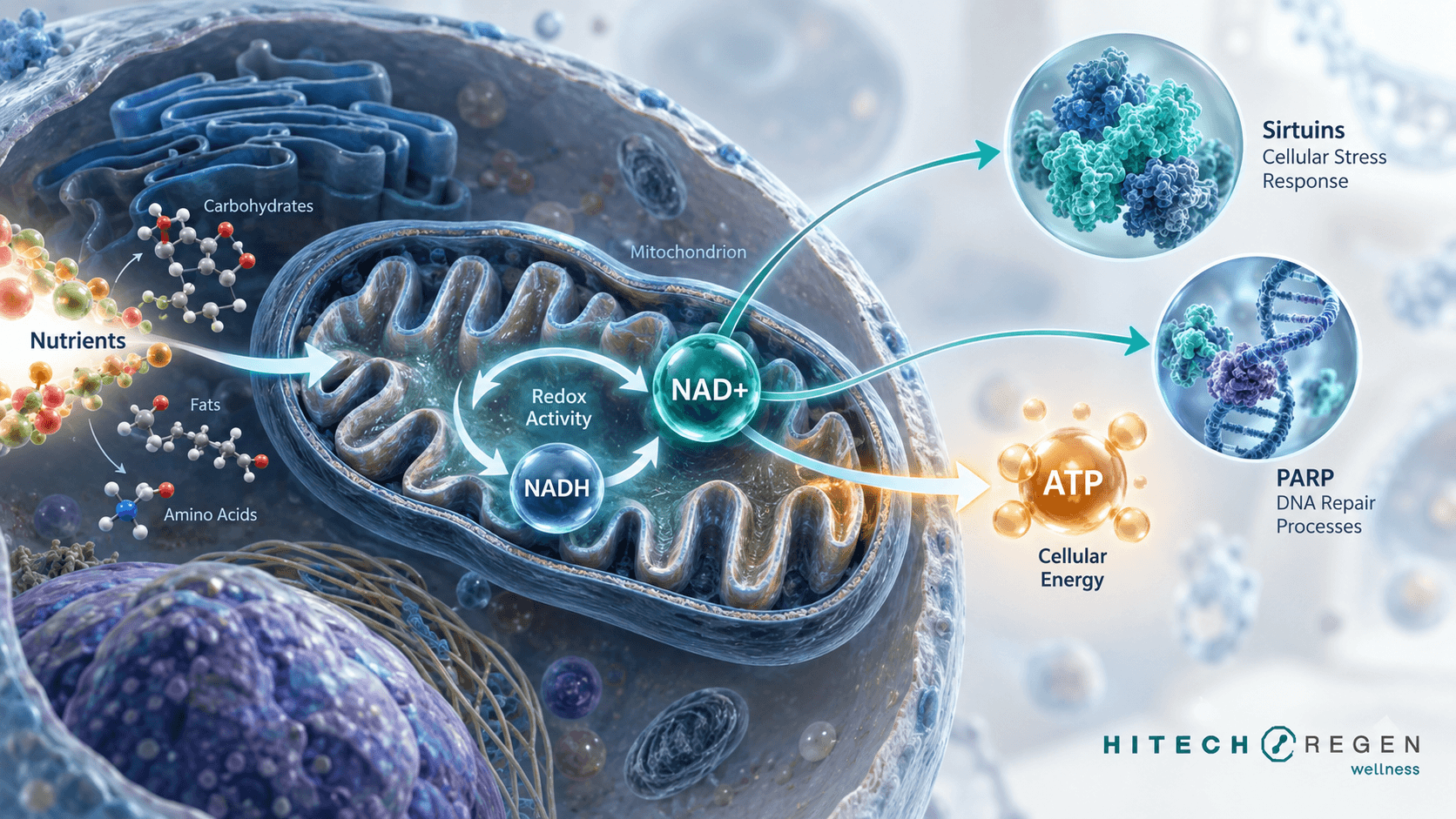
Two facts anchor the whole topic. First, NAD+ levels decline substantially with age; studies cited in National Institutes of Health literature report significant drops across adult decades. Second, oral NAD+ breaks down in digestion, which is why research and clinical practice focus on precursors or on direct infusion. An infusion places NAD+ into circulation at full concentration.
The benefits people pursue, and what the evidence says
| Reported benefit | What is behind it | Evidence maturity |
|---|---|---|
| Energy and reduced fatigue | NAD+ is rate-limiting for ATP production | Mechanism well established; session outcomes reported by patients, formal trials limited |
| Mental clarity and focus | Brain tissue is metabolically demanding and NAD+ dependent | Early research and patient reports |
| Healthy-aging support | Sirtuin and DNA-repair pathways require NAD+ | Strong preclinical work; human longevity outcomes unproven |
| Recovery after exertion or illness | Cellular repair processes are energy intensive | Patient reports; formal studies limited |
| Craving and mood support | NAD+ protocols have a history in addiction-recovery settings | Small studies and clinical experience, not conclusive |
The honest summary: the biochemistry is solid, the human trial base for infusions specifically is still thin, and no reputable provider should promise outcomes. That framing matters more in this niche than in most, and our FAQ page covers how we talk about evidence across every therapy we offer.
Wondering whether NAD+ therapy is right for you?
Benefits on paper are one thing. Whether a course makes sense for you depends on your goals, your health history and what screening finds. Two minutes of candidacy questions is where that conversation starts.
Physician-guided. Screened candidates only. Serving Southern California at home.
What a session is actually like
A typical NAD+ session runs one to several hours depending on dose and how your body tolerates the rate. Faster is not better: NAD+ delivered too quickly commonly causes chest pressure, flushing or nausea, all of which resolve when the rate is slowed. An experienced clinician titrates the rate to keep you comfortable.

With in-home care, the practical experience changes more than the medicine does. A licensed clinician arrives at your home, screening and vitals happen on your couch, and you work, read or rest through the session instead of sitting in a clinic chair. For most people the before and after is undramatic on day one. What patients typically describe is steadier energy over the following days, especially across a short series of sessions rather than a single visit.
NAD+ before and after: what actually changes, and when
Search for NAD+ before and after and you will mostly find photographs. That is the wrong yardstick. NAD+ is a metabolic therapy, not an aesthetic one, so the honest before and after is a description of how people function rather than how they look. What patients typically describe is a gradual change in energy and mental clarity over days, most noticeable across a series rather than after a single visit, and highly variable between individuals.
| Timeframe | What patients commonly describe | Worth knowing |
|---|---|---|
| During the session | Warmth, mild chest pressure or a flushed feeling if the rate is too quick, which settles when it is slowed | Comfort is a pacing question, not a sign the therapy is or is not working |
| The rest of day one | Usually undramatic. Some people feel tired afterward, some feel alert | A big same-day change is not the expected outcome and not the goal |
| The first few days | Steadier energy through the afternoon, easier focus and better sleep quality are the most common reports | Entirely subjective, and not separable from sleep, stress and diet in the same window |
| Across a short series | Reports become more consistent, which is why protocols are usually built as a series with maintenance | Evidence here is clinical experience and patient reports, not controlled trials |
| Between courses | Effects taper rather than stop abruptly; NAD+ is consumed continuously by normal metabolism | How long anything lasts is individual, so maintenance timing is set clinically |
How long the effects last
There is no fixed duration, and any provider quoting one precisely is overselling. NAD+ is consumed continuously by normal metabolism, so a session raises availability rather than topping up a tank that then stays full. Patients who describe a benefit usually describe it fading gradually over weeks, which is the reasoning behind a loading series followed by occasional maintenance. Your own timing should come from how you actually respond, reviewed with a physician, not from a package schedule.
What to track instead of photos
If you want an honest personal before and after, write down three or four specific things before your first session: afternoon energy on a one to ten scale, how many hours of useful focus you get, sleep quality, recovery time after exercise. Re-score them weekly. Subjective measures are still measures, and they are far more informative than a photograph for a therapy that works on metabolism. They also give your physician something concrete to adjust against.
Side effects and safety
Reported side effects are mostly rate effects: chest tightness, warmth or flushing, nausea, lightheadedness and headache, which settle when the rate is slowed or paused. Soreness at the site is possible with any infusion. NAD+ has a long record of use in wellness and recovery settings, but candidacy still matters. Pregnancy, certain cardiac conditions and some medication profiles call for extra caution or a different plan, which is why physician screening comes first. Serious reactions are uncommon in practice, and any provider should be equipped to manage them.
How NAD+ fits a broader plan
NAD+ supports cellular energy metabolism, which makes it a common companion to other regenerative protocols rather than a competitor to them. Patients exploring exosome therapy for recovery goals, or reviewing options across our longevity and vitality conditions hub, often discuss NAD+ as the metabolic foundation of the plan. The full protocol details live on our NAD+ therapy page.

How Hitech Regen approaches it
Hitech Regen delivers physician-guided NAD+ therapy at home across Southern California from our Tarzana base. Every course starts with screening and a physician conversation about goals and expectations; dosing and pacing are set clinically, not off a menu; and nobody is sold a series who is not a candidate for one.
Frequently asked questions
How long does it take for NAD+ IV therapy to work?
Most patients describe changes in energy and clarity over the days following a session rather than immediately, and effects are usually more noticeable across a short series. Individual responses vary, and a physician can help set realistic expectations for your situation.
What does NAD+ before and after actually look like?
Not a photograph. NAD+ works on metabolism, so the realistic before and after is how you function: afternoon energy, hours of useful focus, sleep quality, recovery after exercise. Score those before your first session and weekly afterward, and you will have a far more honest comparison.
How long does NAD+ IV therapy last?
There is no fixed duration. NAD+ is consumed continuously by normal metabolism, so reported effects taper gradually over weeks rather than stopping abruptly. That is why protocols usually pair a short loading series with occasional maintenance, timed to how you personally respond.
What are the negative side effects of NAD+ IV therapy?
The common effects are tied to delivery speed: chest pressure, flushing, nausea or lightheadedness that resolve when the rate is slowed. Soreness at the site is possible. Screening for pregnancy, cardiac history and medications comes before any session.
How often should you get NAD+ sessions?
There is no universal schedule. Many protocols begin with a short loading series and move to occasional maintenance sessions, but frequency should be set by a physician based on your goals, response and health profile.
Is NAD+ IV therapy FDA approved?
No. NAD+ therapy is a wellness therapy, not an FDA approved treatment for any disease. The underlying biochemistry is well studied, but providers should present the therapy as supportive care, not as a treatment or cure.
Is NAD+ better as an infusion than as a supplement?
They are different tools. Oral NAD+ degrades in digestion, so supplements typically use precursors instead, while an infusion delivers NAD+ directly into circulation. Which fits you better is a conversation about goals, budget and physician guidance.
Does NAD+ IV therapy help with anti-aging?
NAD+ is central to pathways that aging research cares about, including sirtuin activity and DNA repair, and levels decline with age. That makes it a rational support for healthy aging, but human evidence that infusions extend longevity does not yet exist.
Curious whether NAD+ therapy fits your goals?
Start with the two-minute candidacy check, or talk it through with our physician team. We come to you, anywhere in Southern California. If a course is not right for you, that is what you will hear.
Physician-guided. Clinician-administered at home across Southern California.