
What to Expect: A Patient Guide to Regenerative Care at Home
If you are reading this, you have probably spent a while being managed rather than helped. Maybe you are tired much of the time, recovering slowly from something, or living with a condition that never quite settles. You have heard that regenerative care might be worth exploring, and now you want to know what actually happens if you reach out. Not the science, just the process.
This guide walks you through it, from the moment you fill in the form to the moment a clinician arrives at your door. Hitech Regen provides physician-guided regenerative care at home across Southern California, so you can look into your options without traveling to a clinic. Here is what to expect, step by step, and what you can ask us along the way.
One thing to settle up front, because most people want to know: a licensed provider is involved from the beginning. No plan is made, and no visit is scheduled, until a provider has reviewed your situation and decided it is appropriate. Nothing here happens on your say-so alone, and nothing happens on ours.
How care starts
It begins with a short form. You share a few basics: your name, how to reach you, your ZIP code, and consent to be contacted. There is nothing to decide yet, and there is no cost to ask.
Once we have your details, our team gets back to you. During business hours, Monday to Friday, 9 am to 5 pm, that is usually within a couple of hours. The first contact is a phone call, and it is short, up to about ten minutes. We use it to understand why you reached out, answer your first questions, and explain what a consultation involves. Nothing is chosen from a menu, and nothing is sold on that call.
If it makes sense to continue, we arrange your consultation with a licensed provider.
What the consultation covers
The consultation is a real clinical conversation, not a formality. A licensed provider reviews your health history and asks about the symptoms or goals that brought you in. Bring the full picture: how you have been feeling, what you have already tried, and what you are hoping to change.
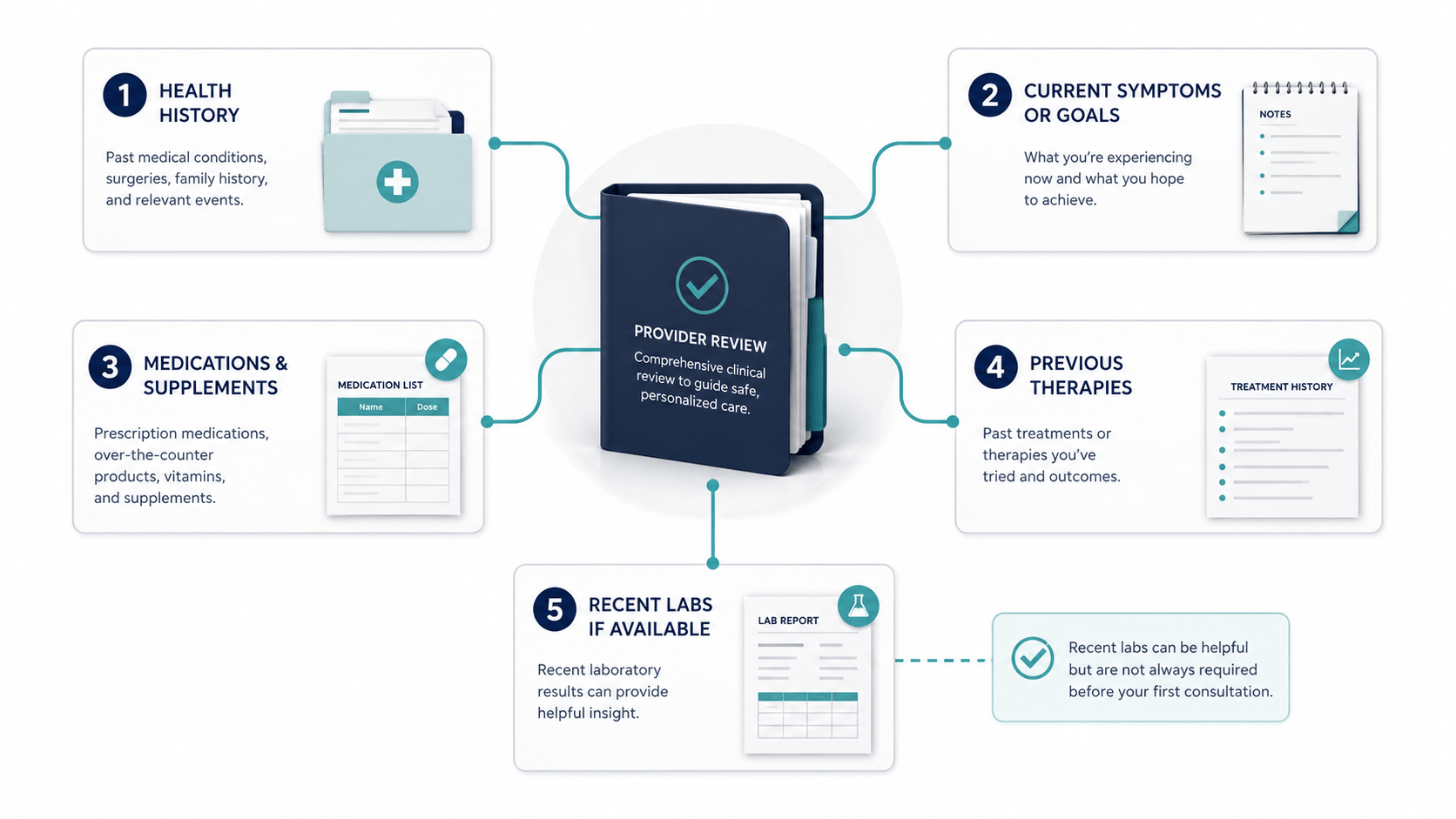
Your current medications matter here, so have your list ready, including any supplements. The provider will ask about past therapies, recent lab work if you have it, and your general health, because all of that shapes what may or may not be appropriate for you. Labs are not always needed before a first consultation, so do not let a missing result stop you from starting the conversation.
This is also your time to ask. If you want to understand how a therapy is studied, what it is designed to support, or why the provider is leaning one way rather than another, ask. A good consultation should leave you with fewer open questions than you came in with.
By the end, you should understand two things clearly: whether regenerative care is a reasonable fit for your situation, and what a licensed provider would suggest if it is. If it is not the right path for you, we will tell you that too. If that sounds like the conversation you have been missing, you can request a consultation through our contact form whenever you are ready.
What happens if you are a good fit
If the provider decides you are a candidate, any plan is set by a licensed provider, not selected from a catalog. The therapies offered, such as exosome therapy, NAD+ therapy, MUSE cell therapy, and stem cell therapy, are always planned around your history and goals rather than picked in advance.
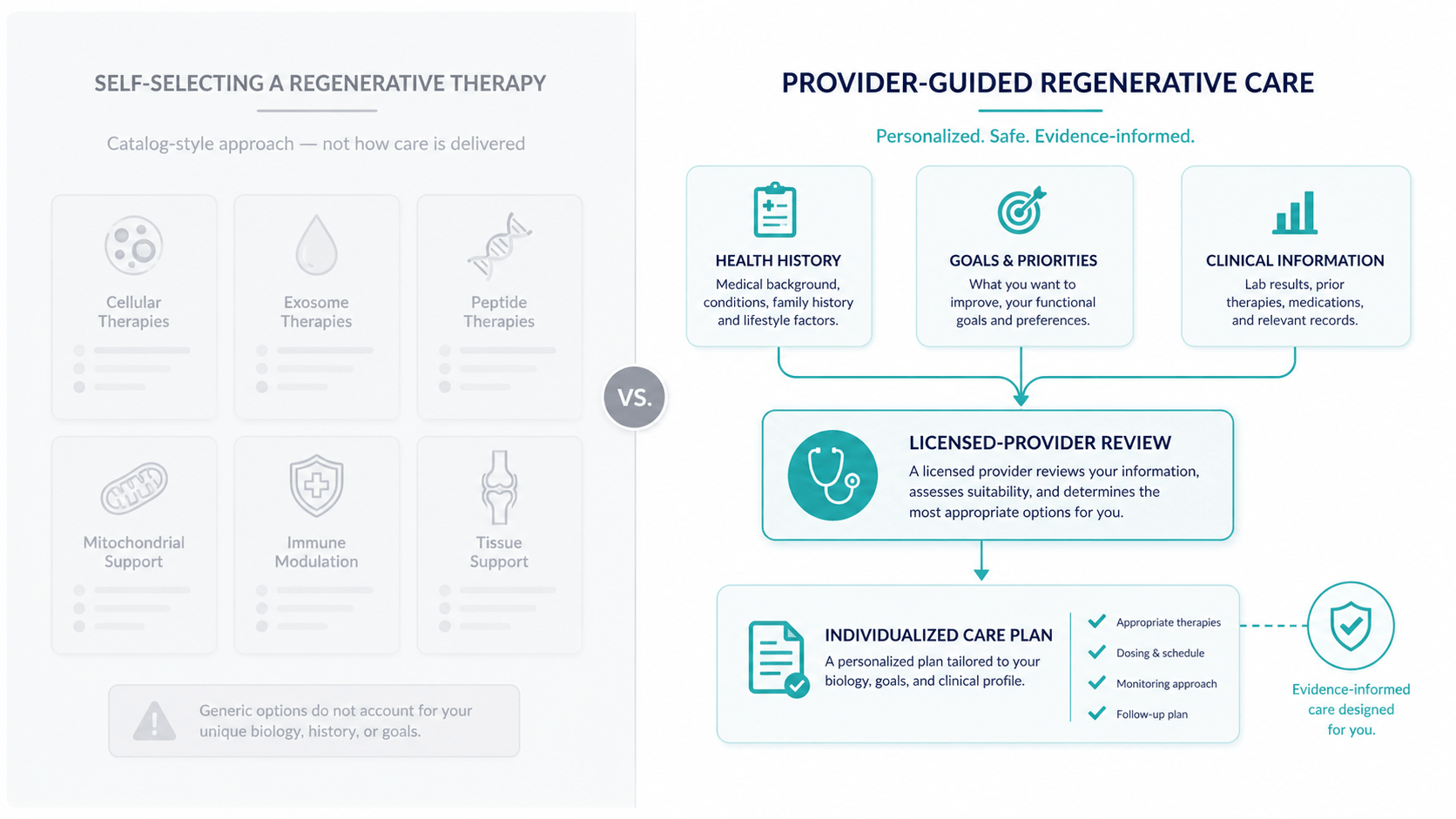
These are wellness support pathways. They are meant to complement the care your own physician provides, never to replace it, and never to treat a named disease. Each therapy has its own page explaining how it is studied and what it is designed to support, for example exosome therapy, so you can read at your own pace before deciding anything.
Care is delivered where you are. Across Southern California the model is mobile, so the visit comes to your home rather than you coming to a clinic. When a plan is agreed, a visit can often follow as soon as the next business day.
What a home visit looks like
On the day, a licensed clinician arrives, working under physician oversight. Discretion is part of the service. Nobody arrives in branded clothing, and no vehicle is marked, so a visit looks like any other appointment to anyone outside.
You do not need to prepare much. A comfortable place to sit or lie down is enough, along with the medication list you gathered earlier. Wear something relaxed, and keep water nearby.
Plan for anywhere from thirty minutes to about two hours, depending on what is involved. The clinician explains each step as they go, so you are never left guessing, and the visit is meant to be private, unhurried, and professional. During the visit you can ask questions at any point, and afterward the clinician will let you know what is normal to feel and roughly how long that usually lasts. You can see more about how in-home care works before you book, so nothing on the day is a surprise.
After the visit
When the visit is done, the clinician will tell you what to expect in the hours that follow and how you might feel. Follow-up is part of the process, not an afterthought. Someone checks in, and that contact helps guide any next steps and ongoing planning.
You will be told who to contact if you have a question afterward, and what, if anything, to watch for. If something does not feel right, you reach the same team, not a call center. Individual responses vary, and no specific outcome is promised, which is exactly why the follow-up conversation matters.
How to prepare, and what to ask
You can make the consultation more useful with a little preparation. Write down your main symptoms or goals, list your medications and supplements, and note anything you have already tried. If you have recent lab work, keep it within reach.
It is also fair to interview any regenerative provider before you commit. Here are questions worth asking, and you are welcome to ask us these too:
- Who sets my plan, and are they a licensed provider?
- Is this meant to complement my regular medical care, or replace it?
- What is this therapy studied for, and what is it designed to support?
- What happens if I am not a good candidate?
- What does follow-up look like, and who do I contact afterward?
If a provider cannot answer these plainly, that tells you something. Our answers, along with other common questions, are on the FAQs page.
Who this is not for
Regenerative care is not right for everyone, and we would rather say so early. These pathways are not a treatment for any disease, and they do not promise a specific result. They are considered investigational and are framed as wellness support, so if you are hoping to have a specific named condition treated, this is not that.
Some options also call for a particular clinical setting rather than a home visit, and a provider will tell you if that applies to you. If receiving care at home is not workable for your situation, or if your goals sit outside what these therapies are designed to support, the honest answer at the consultation may be no. That answer is part of doing this responsibly.
If you are simply exploring whether regenerative care at home fits your situation, and you want a licensed provider to look at the whole picture first, you are in the right place. You can see the areas we focus on across our conditions, for example COPD, Parkinson’s disease or type 2 diabetes, to get a sense of where this care tends to apply.
How to take the next step
When you are ready, the next step is simple. Request a consultation through our contact form, share a few details, and our team will get back to you. During business hours, Monday to Friday, 9 am to 5 pm, that is usually within a couple of hours.
There is no cost to ask, and a consultation does not commit you to anything. It is a conversation to understand your goals and review whether regenerative care at home is a reasonable fit. If it is, a licensed provider will plan what comes next. If it is not, you will know that too, and you will have lost nothing by asking.